A parent’s guide from Nev Davies, Specialist Children’s Orthopaedic Consultant Surgeon, with input from Dan Rolton, Specialist Spinal Orthopaedic Surgeon
Cricket season brings something special, long evenings, team spirit, and children and teenagers developing skills that go far beyond sport. It improves fitness, builds confidence, and teaches resilience in a way few activities can.
For most youngsters, cricket is overwhelmingly positive. But if your child bowls, particularly fast bowling, there is one area that deserves a bit of thought, how we manage the physical demands on a growing body.

This is something Dan and I discuss regularly in clinic. We often see different sides of the same problem, Dan from a spinal perspective, and me from a broader paediatric and knee-focused viewpoint. What’s striking is how often the underlying issue is the same, not the sport itself, but how load is introduced and managed over time.
The reassuring part is this, with a few simple principles, cricket is not only safe, but one of the best sports your child can play.
Why fast bowling needs careful management
Fast bowling places repeated stress through the lower back. In teenagers, especially during rapid growth, the skeleton is growing faster than it is strengthening. That mismatch creates a window where the spine is more vulnerable to what we call flexion / extension or bending overload.
As Dan often puts it when we’re discussing these cases,
“It’s not the action itself that causes trouble, it’s when the body isn’t ready for the volume being asked of it.”
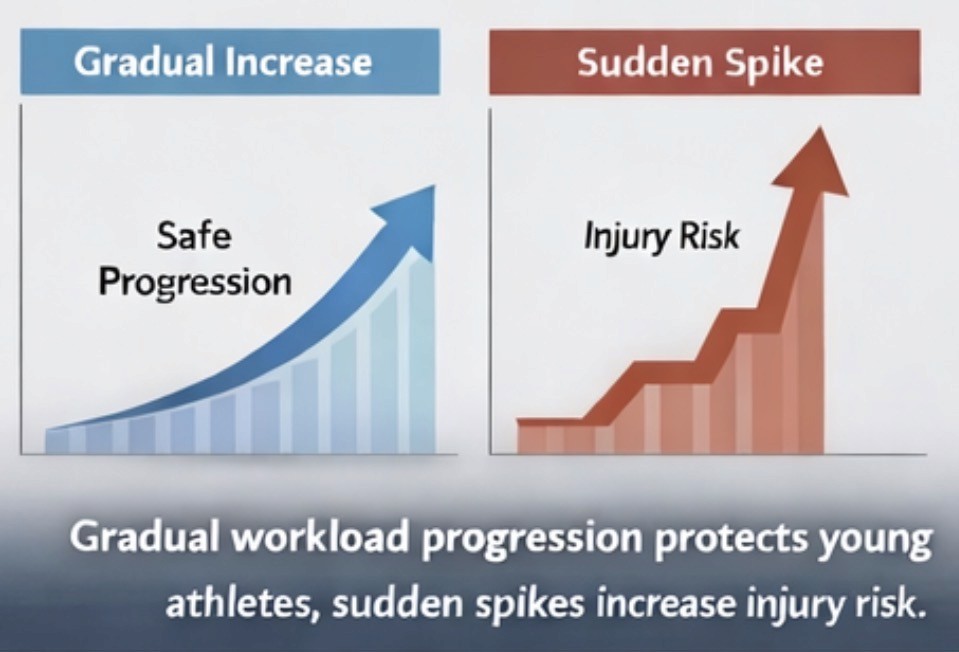
The key issue is not bowling itself, but how quickly workload increases. Sudden spikes, rather than steady progression, are what tend to cause problems.
When these injuries occur, they can take months to recover. Our shared aim, whether we’re seeing these athletes in clinic or advising parents, is to spot risk early and prevent them altogether.
What the guidelines actually say
Both the England and Wales Cricket Board and Cricket Australia have produced clear guidance based on years of research.
For younger players, this translates into sensible weekly bowling limits and, just as importantly, built-in rest.
An 11-year-old, for example, should typically be bowling somewhere in the region of 12 to 16 overs per week, spread sensibly rather than clustered into a couple of heavy days.
As players get older, those numbers increase gradually, but the underlying principle never changes, consistency protects, while sudden increases carry risk.
Both organisations also emphasise the importance of regular lighter weeks during the season and proper breaks at the end of it. Cricket Australia, in particular, highlights the period around growth spurts as a time to be especially cautious.
Weekly Bowling Targets
Age | Overs per Week | Notes |
|---|---|---|
Under 11 | 12 to 16 overs | Max 4 days per week |
12 to 13 | 16 to 20 overs | Avoid back-to-back days |
14 to 15 | 20 to 24 overs | Monitor fatigue |
16 to 17 | 22 to 26 overs | Structured workload |
18 to 19 | 24 to 28 overs | Gradual progression |
The idea that makes the biggest difference
If there is one concept worth remembering, it’s this:
The body copes well with what it is prepared for, not with what surprises it.
A child who bowls a steady amount each week will usually adapt well. A child who goes from very little bowling to multiple matches in a short space of time is far more likely to run into trouble.
This is something Dan and I see repeatedly, often talented, enthusiastic young athletes who simply do too much, too quickly. Not because anyone has done anything wrong, but because cricket seasons can suddenly accelerate, school, club, district, festivals, and before you know it, the workload has doubled.
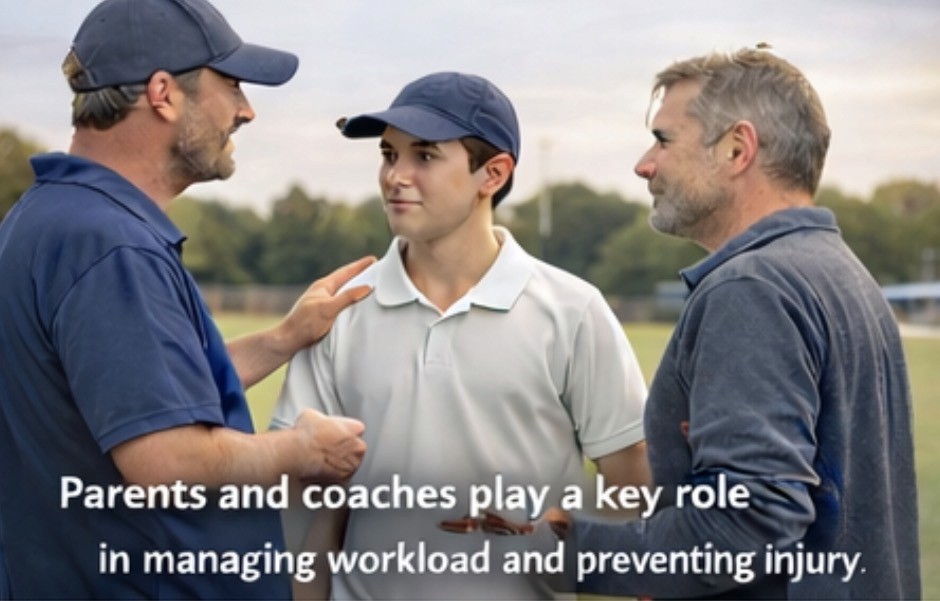
That’s where parents and coaches can make a huge difference, not by restricting participation, but by smoothing out the peaks and troughs.
What this means in real life
In practice, this doesn’t need to be complicated.
Try to avoid packing too much into short periods. If there’s been a busy week of matches or training, the following week should be lighter. After time off, whether that’s holidays or injury, a gradual return over a few weeks is far safer than jumping straight back into full intensity.
Warm-ups are often overlooked but make a real difference. A few minutes spent getting the body moving, activating the core and loosening the hips prepares the spine and legs for what’s to come.
From Dan’s perspective, good trunk control and spinal conditioning are key. From mine, it’s about movement quality and how load is transferred through the lower limbs. We’re essentially looking at the same system from different angles, and when those pieces are working well together, injury risk drops significantly.
Strength and conditioning plays a quiet but important role too. Stronger muscles around the hips and core help absorb the forces that would otherwise be transmitted through the spine and knees.

And perhaps most importantly, children are very good at telling us when something isn’t right, if we listen. Persistent back discomfort after bowling, or stiffness the next day, is not something to push through. Early assessment nearly always leads to a quicker and simpler recovery.
What about the knee?
While the focus is often on the back, I also see a significant number of young cricketers with knee pain, particularly around the kneecap or related to growth and load.
Interestingly, the same principles apply.
Whether it’s the spine, as Dan sees, or the knee, as I see, the pattern is familiar, gradual progression works well, spikes in activity do not.
When movement patterns are good and workloads are sensible, problems are relatively uncommon. When those elements are missing, issues tend to follow.

Keeping cricket what it should be
It’s easy to become overly cautious when we talk about injuries, but it’s important to keep things in perspective.
Cricket offers children a huge amount, physically, socially, and mentally. The aim is not to limit that experience, but to support it so that children can stay involved, improve, and most importantly, enjoy it.
One of the most rewarding parts of working together on this topic is that Dan and I are completely aligned on that goal, keep children playing sport, but do it intelligently.
A simple takeaway
You don’t need to stop your child bowling, you just need to manage it sensibly.
If you’re unsure
If your child develops knee or back pain that isn’t settling, getting the right advice early can make a big difference, both in terms of recovery and confidence returning to sport.\