
When parents think about helping their child perform well in sport, they often focus on the obvious things: training sessions, specialised coaching, nutrition, new boots or equipment.
But there is one powerful performance enhancer that is frequently overlooked.
Sleep.
If sleep were available as a supplement that improved performance, accelerated recovery and reduced injury risk, every athlete in the world would be taking it.
Yet many young athletes today are chronically sleep deprived.
In my clinics I regularly see highly motivated teenagers training several times a week, balancing school and competition, but sleeping far less than their bodies need.
For growing athletes, sleep is not optional recovery, it is essential training.
Why Sleep Matters for Young Athletes
Adolescence is a period of rapid physical development. During this time the body is growing, adapting and responding to training loads.
Much of this adaptation happens during sleep.
Growth and Physical Development
Deep sleep triggers the release of growth hormone, which plays a crucial role in:
Bone development
Muscle growth
Tissue repair
Recovery from training
This is particularly important in young athletes whose bodies are still developing.
Muscle Recovery
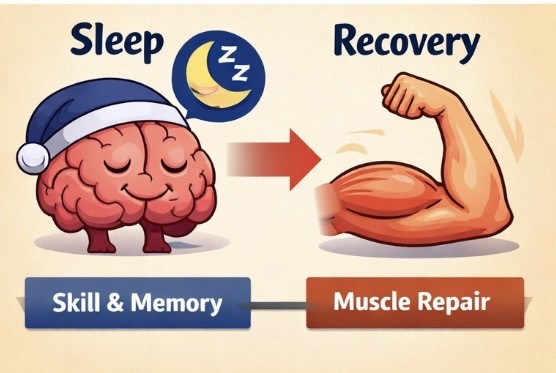
Training creates small amounts of muscle damage that the body repairs and strengthens during recovery.
Sleep helps restore:
muscle tissue
energy stores (glycogen)
immune function
Without adequate sleep, recovery simply cannot keep up with training demands.
Learning and Skill Development
Sport is not just a physical phenomenon it is neurological phenomenon.
During sleep the brain consolidates motor learning, helping young athletes retain and refine skills they practised during the day.
This includes:
coordination
reaction time
decision making
technical skill development
Quite simply, sleep helps lock in the training you did earlier.
Sleep and Injury Risk
One of the most important reasons sleep matters in youth sport is its link to injury prevention.
Fatigue affects how the body moves and reacts.
When athletes are tired, they are more likely to experience:
slower reaction times
reduced coordination
poorer movement control
altered biomechanics
All of these factors increase the risk of injury.
Research has shown that teenage athletes who sleep less than eight hours per night are significantly more likely to suffer sports injuries.
From my perspective as a knee surgeon, fatigue can influence neuromuscular control around the knee, which may contribute to injuries such as ligament sprains or ACL tears.
In other words:
Sleep is part of injury prevention.
The Modern Challenge
Unfortunately, modern life is not always sleep-friendly for teenagers.
Common barriers include:
late-night phone use and social media
gaming and screen exposure
early school start times
busy training schedules
academic pressures
Many teenagers are going to bed later than ever but still waking early for school.
The result is a sleep deficit that accumulates throughout the week.
Weekend “catch-up sleep” rarely fully compensates.
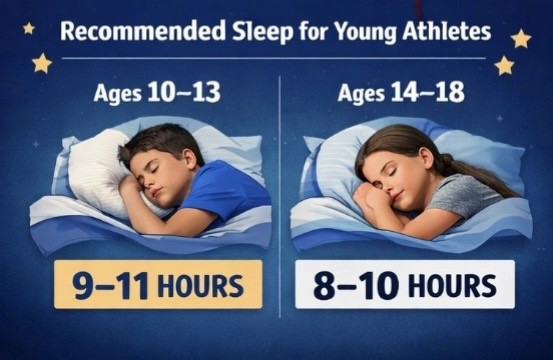
How Much Sleep Do Young Athletes Need?
Most adolescents require between 8 and 10 hours of sleep per night.
For younger teenagers and very active athletes, closer to 9–10 hours is often ideal.
As a simple guide:
Practical Tips to Improve Sleep
Improving sleep habits does not require complicated interventions.
Small changes can make a big difference.
1. Reduce Screen Time Before Bed
Phones, tablets and gaming devices stimulate the brain and delay sleep.
Ideally, screens should be switched off around 60 minutes before bedtime.

2. Maintain a Consistent Bedtime
The body’s internal clock works best with routine.
Going to bed and waking up at roughly the same time each day helps regulate sleep cycles.
3. Create a Sleep-Friendly Environment
A good sleep environment should be:
cool
dark
quiet
4. Avoid Late Caffeine
Energy drinks or coffee late in the day can interfere with sleep quality.
5. Balance Training and Recovery
Young athletes need rest days and recovery periods alongside training.
Sleep is the most powerful recovery tool they have.
The Bigger Picture in Youth Sport
In youth sport we often focus on training harder, doing more sessions, or specialising earlier.
But performance and development are built on recovery as much as effort.
Sleep supports:
physical development
skill learning
mental wellbeing
injury prevention
Encouraging healthy sleep habits may be one of the simplest ways parents and coaches can support young athletes.
Final Thoughts
Young athletes do not just need more training.
They need smart training and effective recovery.
Sleep is the foundation that allows the body to adapt, grow and stay healthy.
Ask yourself a simple question:
Are they getting enough sleep?