I use golf a lot when I teach. Partly because I love the game, but mostly because it is the cleanest analogy I have found for what surgical practice actually asks of you.
Golf has actually followed me through my surgical career. Back in 2006, as a trainee, I wrote a slightly tongue-in-cheek piece for BMJ Careers called Impressing your boss on the golf course. Twenty years later, I’m still using golf to think about surgical training, although these days the lessons have rather less to do with impressing the boss.
https://www.bmj.com/content/332/7538/s69.full
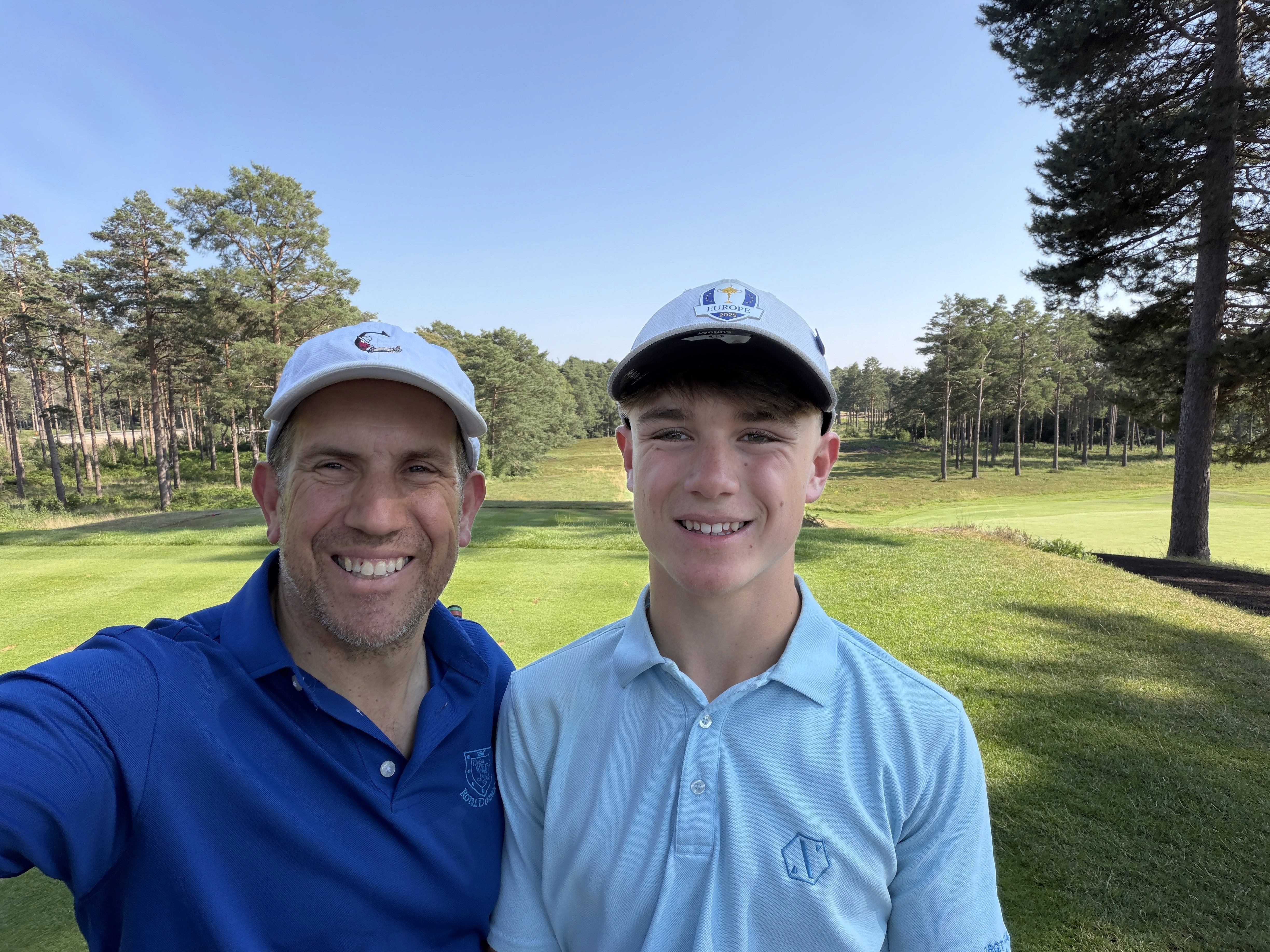
Caption: Golf has followed me through my surgical career, and into the next generation.
Both playing golf and operating are technical skills performed under scrutiny. Both require endless preparation for a relatively short period when it actually counts. And in both, the outcome depends far less on your best shot than on how you handle the ones that go wrong.
The best lesson golf has taught me about surgery is not how to hit the perfect shot.
It is what to do after the imperfect one.
Here is the version I give trainees, played as a single hole.
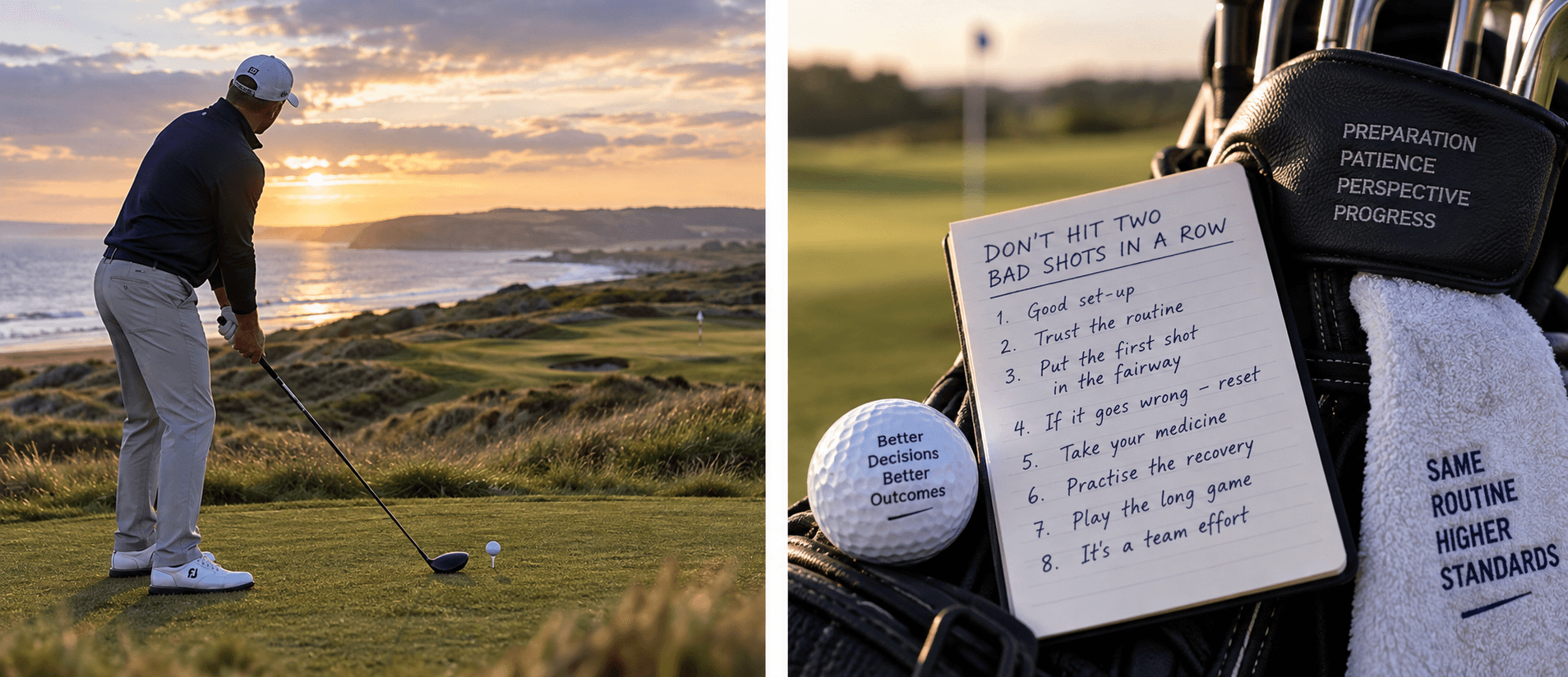
Caption: The lessons of golf and surgery are often found in what happens before and after the shot.
Before you swing: the set-up
Caption: The set-up is the part nobody watches, and the part that decides everything.
Watch any good golfer and the swing is almost the least interesting thing about them.
It is everything before it that repeats: the grip, alignment, ball position, distance from the ball. The same little sequence, every single time.
Surgery is remarkably similar.
Patient positioning, drapes, the order the instruments are laid out, the WHO checklist, the height of the table. Get those things right and reproducible, and the operation you are about to do becomes shorter and simpler. Get them wrong and you can spend the next hour compensating for a problem you created before you picked up a knife.
Trainees naturally want to talk about the difficult bit in the middle.
The consultants I most admire are obsessive about the bit at the beginning.
The routine is not superstition
Every good golfer has a pre-shot routine. It can look like a quirk until you understand what it is for.
It isn’t luck.
It is a way of making the swing on the eighteenth green, in front of a crowd, feel as much as possible like the swing on the practice range.
The theatre equivalent is the same series of checks, in the same order, on the straightforward case and the complex one.
The routine isn’t really there for the easy days.
It is there for the day when the operation is taking longer than expected, the anatomy isn’t quite what the scan suggested and you are tired.
That is precisely when a habit can outperform a decision.

Caption: A good set-up gives you options. A poor one makes every shot that follows harder.
Put the first shot in the fairway
The easiest way to make your second shot difficult is to put your first one in the trees.
In surgery, your first shot is often your approach and your exposure.
Neither is glamorous. Neither is usually the bit that gets photographed or demonstrated at a conference. But both determine how difficult everything that follows is going to be.
If you are fighting for a view an hour into an operation, the decision that caused the problem was often made in the first ten minutes.
Watch what happens when a registrar is struggling and a consultant scrubs in to help. One of the first things they will often do is extend the incision or improve the exposure.
Not a clever technical trick. Not a different implant. Not faster hands.
A better view.
It is striking how often the problem was never really the operation. It was that nobody could see it properly.
Don’t hit two bad shots in a row
This is probably the golf lesson I use most when teaching surgery.
Every surgeon has cases that do not go according to plan. Complications occur even in excellent surgical practice. What matters enormously is how you recognise the problem, respond to it and learn from it.
Golf is exactly the same.
A tee shot into the trees is annoying, but usually recoverable. What destroys the hole is the furious, ambitious, half-considered swing that comes immediately afterwards.
Suddenly the ball is behind another tree, you are still nowhere near the green and a bogey has become a seven.
The same failure mode exists in theatre, and it is often emotional rather than technical.
Something hasn’t gone to plan. You are irritated with yourself. You are conscious of the clock, the team and the patient on the table. There is an enormous temptation to fix the problem immediately.
That is precisely when you need to stop.
Reset.
Look again.
And make the next decision on its own merits rather than as a reaction to the one before it.
The bad shot is rarely the thing that ruins the round.
Take your medicine

Caption: Sometimes the safest route is the one that leaves you with another shot.
You are in the trees.
There is a tiny gap through the branches which, if you pull off the shot of your life, will put you on the green and make you a legend for the rest of the afternoon.
There is also a simple wedge sideways onto the fairway.
Take the wedge.
In surgery, taking your medicine might mean extending the incision, reverting to the simpler implant, changing the approach, calling for help or accepting that today’s operation is going to be the safe operation rather than the elegant one.
None of those decisions feels particularly clever at the time.
That is partly why they are difficult.
The hero shot is always more attractive.
Good judgement is knowing when not to play it.
Practise getting out of the bunker
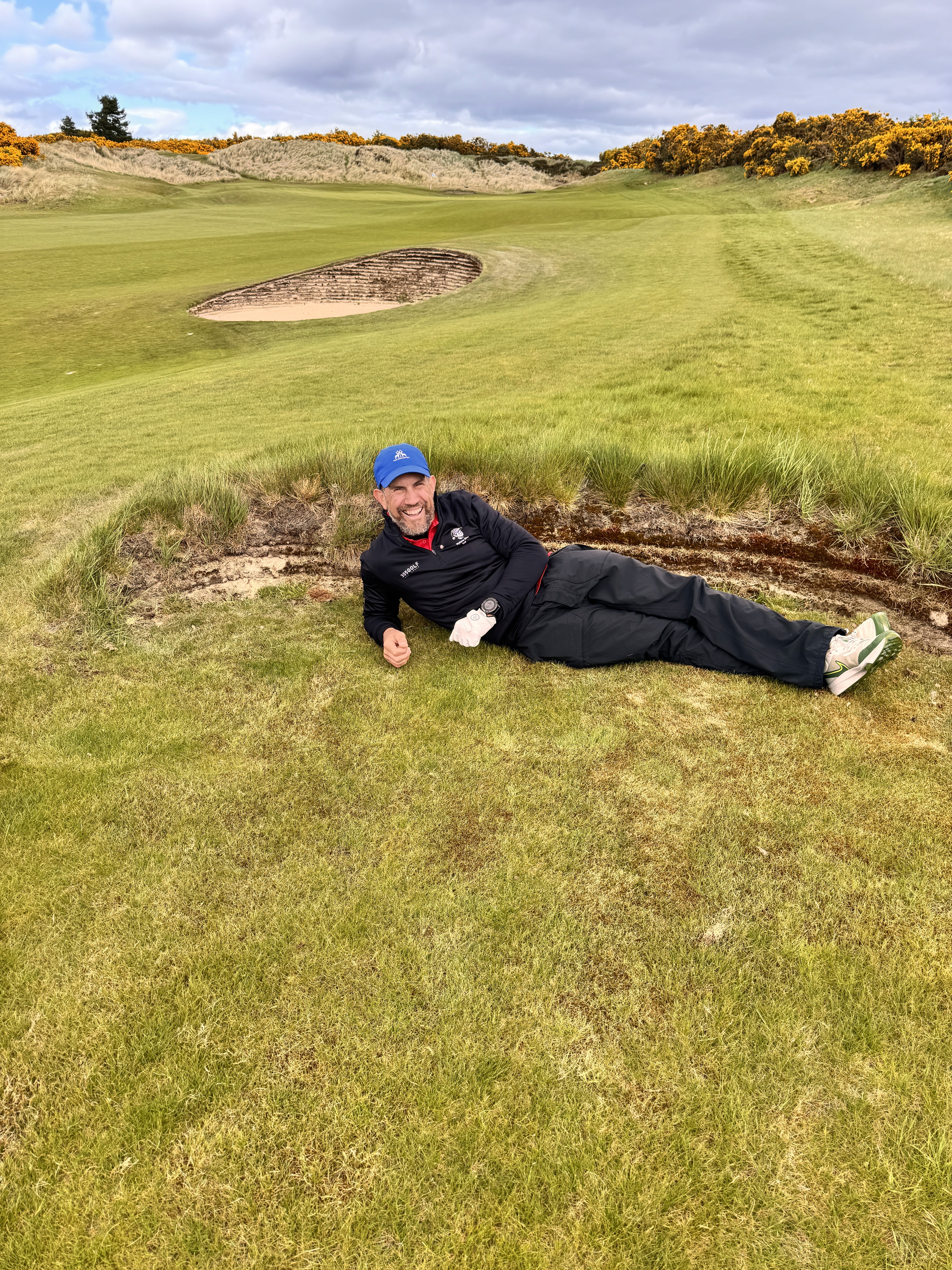
Caption: If you are going to take on difficult shots, you also need to practise the recovery.
There is another side to this.
If you are going to attempt difficult shots, you need to know how to recover when they don’t work.
Before taking on a difficult case, you should be able to answer two questions honestly:
What is my plan when Plan A fails?
And:
Can I actually execute it?
If the answer to the second question is no, the solution isn’t to be braver. It is to practise the recovery or do the case with someone who can play it.
Golfers have one enormous advantage over surgeons: they have a driving range.
There is no practice swing on a patient.
So our practice has to happen everywhere else: the cadaveric lab, sawbones, simulation, the approach you only use twice a year rather than the one you do every Tuesday, and the quiet ten minutes the night before a difficult case when you walk through the operation in your head.
And don’t just rehearse the perfect operation.
Rehearse the bail-out.
You already know what you are going to do when everything goes right.
Preparation matters most when it doesn’t.
Skill, and putting under pressure
None of this replaces technical ability.
You still have to be able to hit the shot.
But the distinction between a good club golfer and a professional isn’t simply what their swing looks like on the range. It is what that swing does when it matters.
Surgery is similar.
Most experienced surgeons can operate well on the calm, uncomplicated case when everything is going according to plan.
The job is delivering the same standard on the last case of a long list, when the anatomy is difficult, something unexpected has happened and the room has suddenly gone quiet.
Technical skill matters.
Being able to access that skill under pressure matters just as much.

Caption: The game becomes about more than the score when you are sharing it with someone else.
The scorecard doesn’t lie
In golf you sign for your own score.
Not the score you felt you played. Not the score you would have had if that putt on the ninth had stayed up.
The number.
Written down, with your name beside it.
At this year’s Open at Royal Birkdale, Bryson DeChambeau was given a two-shot penalty after officials ruled that he had inadvertently improved the area of his intended backswing in long grass.
The important word was inadvertently.
It wasn’t intentional.
The scorecard changed anyway.
There is something in that for surgeons.
Good intentions matter, but they cannot be the only way we judge our practice. Equally, a good outcome doesn’t necessarily mean every decision was right, just as a complication doesn’t necessarily mean every decision was wrong.
That is why honest audit matters.
Complications. Revisions. Infections. Patient-reported outcomes.
Recorded rather than remembered.
Not the version of our practice we carry around in our heads, and not the good cases we inevitably remember more vividly than some of the difficult ones.
The numbers.
Written down, with our name beside them.
And the part golf gets wrong
Golf looks like an individual sport.
Surgery can look like an individual job.
One name on the scorecard. One name on the operating list.
Neither is really true.
The caddie reads the green, argues you out of the wrong club and steadies you after the bad hole.
In theatre, the scrub nurse has the next instrument ready before I ask for it. The anaesthetist tells me the patient isn’t tolerating the position. The ODP notices that something has drifted. Someone speaks up when something doesn’t look right.
The best days in theatre feel remarkably like a good round played with people who know your game.
The surgeon takes the credit. The team produces the result.