The short answer: no.
In fact, if anything, the evidence suggests the opposite.
Recreational runners have lower rates of knee arthritis than sedentary people.
Cartilage is living tissue. It is designed to move and tolerate load.
Most knee pain associated with running is a load, training or strength problem, rather than evidence that you are wearing your knee out.
The problems usually start when enthusiasm gets ahead of what the body has had time to adapt to.
I am a knee surgeon who, somewhat accidentally, became an ultrarunner for about five years. I have spent years looking inside knees, operating on them and trying to keep people active. I have also spent rather a lot of time testing the theory on my own knees.
And I have never told somebody to stop running simply because running is supposedly "bad for their knees".
So, let's deal with that myth properly.
Is running bad for your knees?
No. Recreational running does not appear to damage healthy knees, and runners certainly do not simply "wear their knees out".
This remains one of the most persistent myths I hear in clinic.
The argument sounds perfectly logical:
Running involves impact → impact causes wear → therefore running wears out knees.
The problem is that the human body doesn't work like that.
Your knee is not a set of brake pads with a predetermined number of miles in it.
Bone, muscle, tendon and cartilage are living tissues. Give them an appropriate amount of load and recovery and they adapt to it. That is the fundamental principle behind training.
And the long-term studies are reassuring. Recreational runners do not appear to develop more knee osteoarthritis than non-runners. Some studies actually suggest they develop less.
So if somebody tells you that every run is taking a few more miles off your knees, you can politely ignore them.
Does running cause arthritis?
For most recreational runners, no. Running does not appear to increase the risk of knee arthritis and may actually be protective.
There are several good reasons why.
Running makes the machinery around the knee stronger. Your quadriceps, hamstrings, glutes and calves all help control the forces passing through the knee. A stronger leg generally manages load better than a weak one.
Cartilage likes movement and load. Joint cartilage does not have a conventional blood supply. Movement and cyclical loading help move synovial fluid and nutrients through the cartilage. Your joints are designed to move, not to spend their lives on the sofa.
Running helps maintain a healthy body weight. Body weight matters to knees because the forces passing through the joint during everyday activities are several times our body weight. Keeping active is one of the best things you can do for your long-term joint health.
Exercise is good for the whole system. Regular exercise improves cardiovascular health, metabolic health, muscle strength, bone health and general wellbeing. All of those things matter as we get older.
There is, however, an important bit of nuance.
Elite-level running and enormous lifetime training volumes are not quite the same thing as going out for three or four sensible runs each week. Previous major knee injuries, particularly ACL injuries and significant meniscal injuries, can also alter your future arthritis risk.
But that is very different from saying: "Running causes arthritis."
It doesn't.
Why do my knees hurt after running?
Usually because the amount of running you are asking your knee to tolerate has overtaken what it is currently conditioned to do, rather than because you have damaged the joint.
This is the bit I see all the time.
January is particularly good for it.
New trainers. New watch. New Year resolution. Strava activated.
Zero to four runs a week.
Knee hurts.
And suddenly running is blamed for destroying the cartilage.
Usually the knee simply hasn't been given enough time to catch up with the owner's enthusiasm.
Common contributors include:
Too much, too soon. Probably the commonest problem of all.
Not enough strength. Particularly around the quadriceps, glutes and calf.
Suddenly adding hills, speed work or longer runs. These can substantially change the load even if your weekly mileage hasn't changed much.
Poor recovery. Training is only half the equation. Your body adapts between sessions.
Changing shoes or running style abruptly.
Doing exactly the same run, at the same pace, on the same surface, week after week.
Pain around the front of the kneecap is particularly common. It often hurts running downhill, getting up after sitting or walking downstairs.
And, despite how alarming it can feel, this is frequently a very treatable combination of load and strength rather than something being "worn out".
I have written more about that here: Why does my knee hurt going down stairs (but not up)?
Should I stop running if my knees ache?

Usually not. In most cases the answer is to adjust the dose of running while you build the knee's capacity, rather than stopping everything.
This distinction is really important.
If you completely stop every time something aches, you lose fitness and strength. Then you restart at exactly the same level that caused the problem in the first place.
Unsurprisingly, the knee complains again.
A better approach is usually:
Turn the running down rather than off. Reduce the distance, frequency, hills or speed until the symptoms are manageable.
Get stronger. Squats, split squats, lunges, step-ups, calf raises and good single-leg work are all useful.
Think about cadence and stride. For some runners, a slightly shorter, quicker stride can reduce load through the kneecap.
Mix things up. Road, trail, grass, hills, flatter runs, cycling or swimming can all change the stimulus.
Build back gradually. The famous 10% rule is not a law of biology, but the principle behind it is sensible: don't make enormous jumps in training load from one week to the next.
And strength becomes increasingly important as we get older.
If you are over 40 and want to keep running, I would regard regular strength work as part of being a runner, not an optional extra.
If you have genuinely adjusted the training, done the strength work and given it six to eight weeks but things aren't improving, that is a reasonable point to get somebody to have a proper look.
Does running on pavement damage your knees?
No. Running on pavement does not, by itself, damage a healthy knee.
Your body is remarkably good at adjusting to different surfaces.
What I am less keen on is monotony.
The same route, same camber, same shoes, same pace and same loading pattern, thousands and thousands of times.
If you can, mix things up.
I personally loved trail running during my ultrarunning years because every footfall is slightly different. You naturally vary your stride, pace and loading, and there is also something considerably nicer about running through woods than staring at traffic.
But if you love road running, carry on. Tarmac is not secretly grinding away your cartilage.
Do my running shoes matter for knee pain?
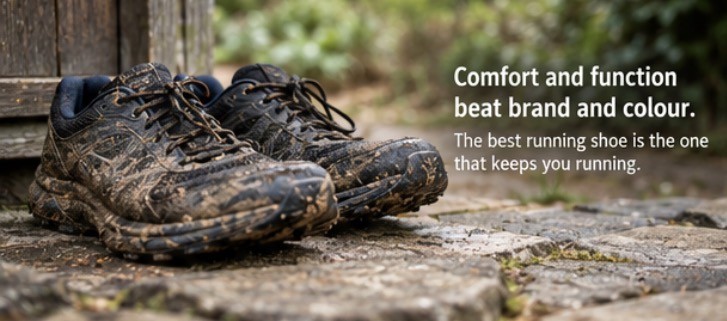
They can do, particularly if they are uncomfortable, badly worn or very different from what your body is used to, but there is no single "best" running shoe for protecting knees.
Running shoes are an industry in themselves, and runners can become slightly evangelical about them.
My approach is much simpler.
Comfort and function beat brand and colour.
A few practical points:
Choose a shoe that feels comfortable when you actually run in it.
Be cautious about making a dramatic change in shoe type at the same time as increasing your training.
If an old pair has become noticeably compressed or uncomfortable, replacing them is sensible.
Don't assume that the most expensive shoe is automatically the best shoe for your knee.
And definitely don't buy a particular model simply because your fastest mate wears it.
If you have a very high or collapsing arch, previous foot or ankle problems, or persistent symptoms despite sensible strength and load management, getting your feet properly assessed can be useful.
Orthotics are not magic and not everybody needs them.
But in the right person, they can make an enormous difference.
I frequently refer patients to Nick Gallogly at Feet First Orthotics because I trust him to work out whether an orthotic will genuinely help rather than simply selling everybody who comes through the door a pair of insoles.
I already have knee arthritis. Can I still run?
Often, yes. An X-ray or MRI showing arthritis does not automatically mean you have to stop running.
This sometimes surprises people in clinic.
They arrive having been told that the scan shows "wear and tear", and therefore running must be doing more damage.
But I treat the patient, not the scan.
If you enjoy running, the knee isn't repeatedly swelling and your symptoms settle reasonably quickly afterwards, I don't automatically see a reason to stop simply because an X-ray has the word arthritis written on the report.
The knee will normally tell you when the dose is too much.
If every run produces a big swollen knee that remains painful for several days, something needs changing.
That might mean shorter runs, fewer runs, more recovery, more strength work or substituting some sessions with cycling, rowing or swimming.
And yes, for some people with more advanced arthritis, running eventually stops being enjoyable.
At that point, finding another way of getting the same physical and mental benefits makes sense.
But make that decision because of your knee and your symptoms, not because somebody frightened you with an X-ray.
When should I get my knee looked at?
Most little running niggles settle.
There are, however, some things I wouldn't ignore.
Get the knee assessed if:
It repeatedly swells after running.
It gives way or feels unstable.
It locks or catches, particularly if you cannot fully straighten it.
You have significant pain at rest or at night.
It isn't improving despite six to eight weeks of sensible load modification and strength work.
There was a proper injury, particularly a twist associated with immediate swelling, and the knee has never been quite right since.
None of those things automatically means surgery.
Far from it.
Most runners I see with knee pain don't need an operation.
Often the most useful thing I can give them is an explanation of what is going on, reassurance about what isn't going on, and a sensible plan to get them back to running.
What I learned from five years of ultrarunning
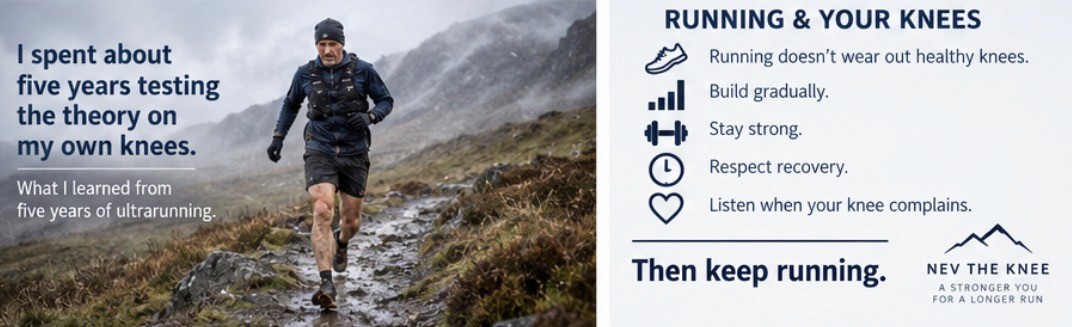
I came to running about ten years ago, largely because I was trying to keep up with my Ironman-obsessed other half.
It got slightly out of hand.
Short runs became longer runs. Longer runs became marathons and, for about five years, I got properly into ultrarunning.
I loved it.
There is something wonderfully simple about putting your trainers on and disappearing for several hours, although I appreciate that may not sound entirely normal to everyone.
I don't really consider myself an ultrarunner these days, but those years taught me quite a lot about running, recovery and, occasionally, my own inability to follow the advice I give patients.
And somewhere along the way I learned something that medical school definitely didn't teach me: the runner's high is genuinely addictive.
It is remarkably good at persuading otherwise sensible people that the correct treatment for a niggle is another 10 km.
I have certainly been guilty of it.
Most of the running problems I have had myself, and many of the ones I see in clinic, haven't happened because running is inherently bad for us.
They happen because we are terrible at listening when our bodies quietly ask us to back off.
We ignore the niggle.
We don't want to miss the long run.
Strava is watching.
There's a race in six weeks.
So we carry on until the whisper becomes a shout.
That is probably the biggest lesson I took from those years.
Running isn't the problem. Running too much, too quickly, on a body that isn't ready for it is the problem.
Get the dose right. Keep your legs strong. Respect recovery. Listen to the early warning signs.
Do that and running is not something you need to protect your knees from.
It is one of the best things you can do for your knees, your heart, your head and, quite possibly, the rest of your life.
So lace up your daps and get out there.
Your knees are rather better designed for it than you might think.