Let me start with the sentence that matters most.
A new or unexplained limp in a child should never simply be ignored.
That is not the same as saying something is seriously wrong.
Most limps in children are caused by something minor, temporary or very treatable. But a limp is a symptom rather than a diagnosis, and the causes range from something as simple as a stone in a shoe to conditions that need treatment urgently.
So the reassurance I can honestly give you is not simply, "Don't worry about it."
It is this: most children with a limp turn out to have something straightforward or treatable, but it is worth knowing when to watch, when to arrange an appointment and when not to wait.
Should I take my limping child to be seen?
Usually, yes. The important question is how quickly.
Here is how I would think about it.
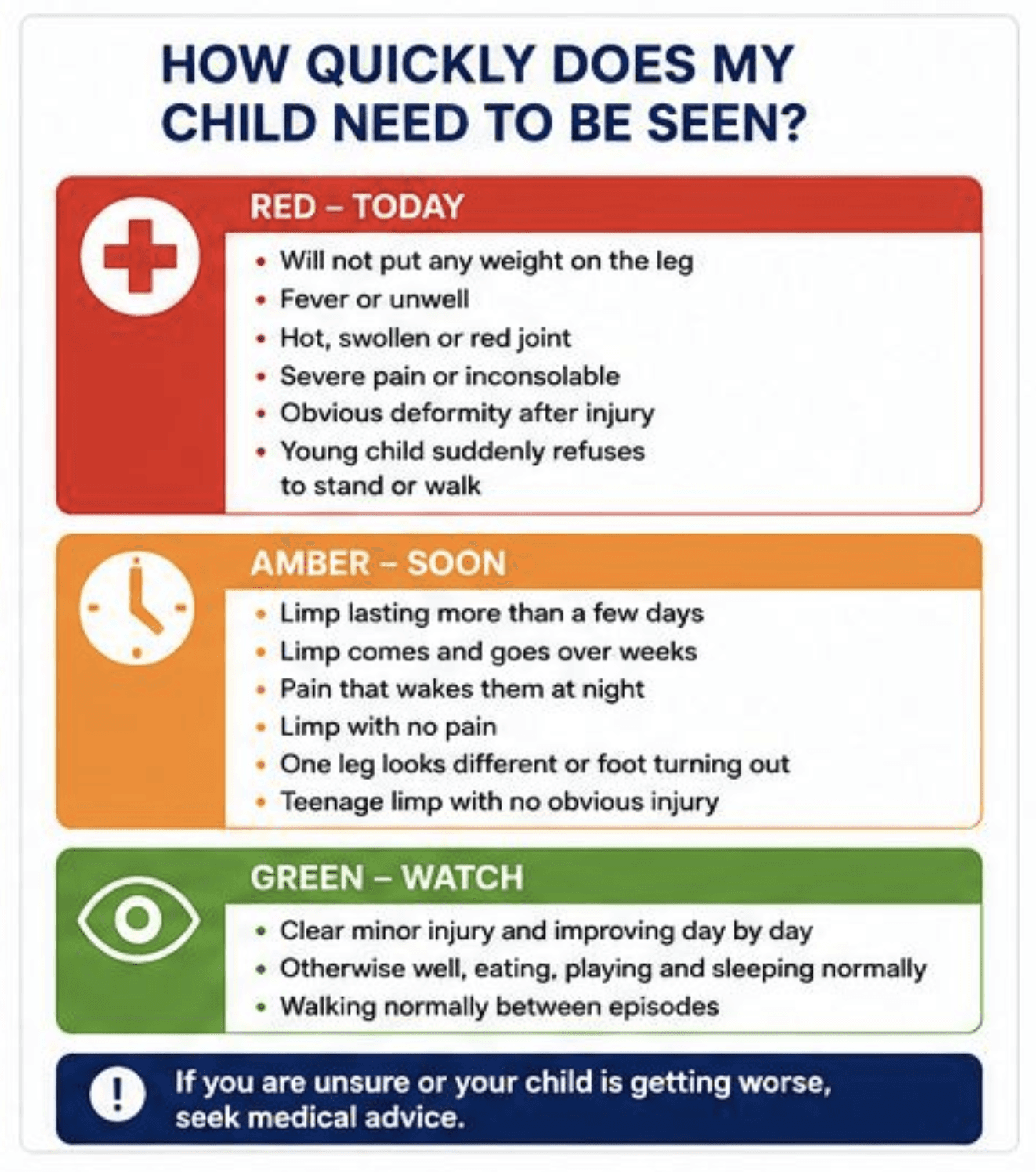
🔴 RED: Seek urgent medical assessment today
Go to A&E, urgent care or call NHS 111 if:
Your child will not put any weight on the leg at all
They have a fever or seem unwell in themselves
A joint is hot, swollen or red
The pain is severe or they are inconsolable
There is an obvious deformity after an injury
A young child suddenly refuses to stand or walk, particularly without an obvious minor injury
An unwell or feverish child who refuses to stand or walk needs assessing that day.
Joint or bone infection is uncommon, but it can be time-critical. It is the one situation on this page where I would not advise waiting overnight to see what happens.
🟠 AMBER: Arrange an assessment soon
Book to be seen if:
The limp has lasted more than a few days and there is no clear injury to explain it
The limp keeps coming and going over several weeks
Pain regularly wakes your child at night
Your child is limping but says they have no pain
One foot is starting to turn outwards or one leg looks different from the other
A teenager develops a new limp without an obvious injury
Things simply do not seem to be improving as you would expect
Parents are often very good at spotting subtle changes in the way their child walks. If something continues to look different, it is worth getting it checked.
🟢 GREEN: Reasonable to watch for a few days
It is usually reasonable to watch initially if:
There has been a clear, witnessed minor injury
The limp is improving day by day
Your child is otherwise well, eating, playing and sleeping normally
They are increasingly walking normally and returning towards their usual activities
If the limp is not continuing to improve or has not settled within about a week, move it into the "arrange an assessment" group.
Why do children limp without complaining of pain?
Children are not small adults, and they do not always report pain in the way we expect them to.
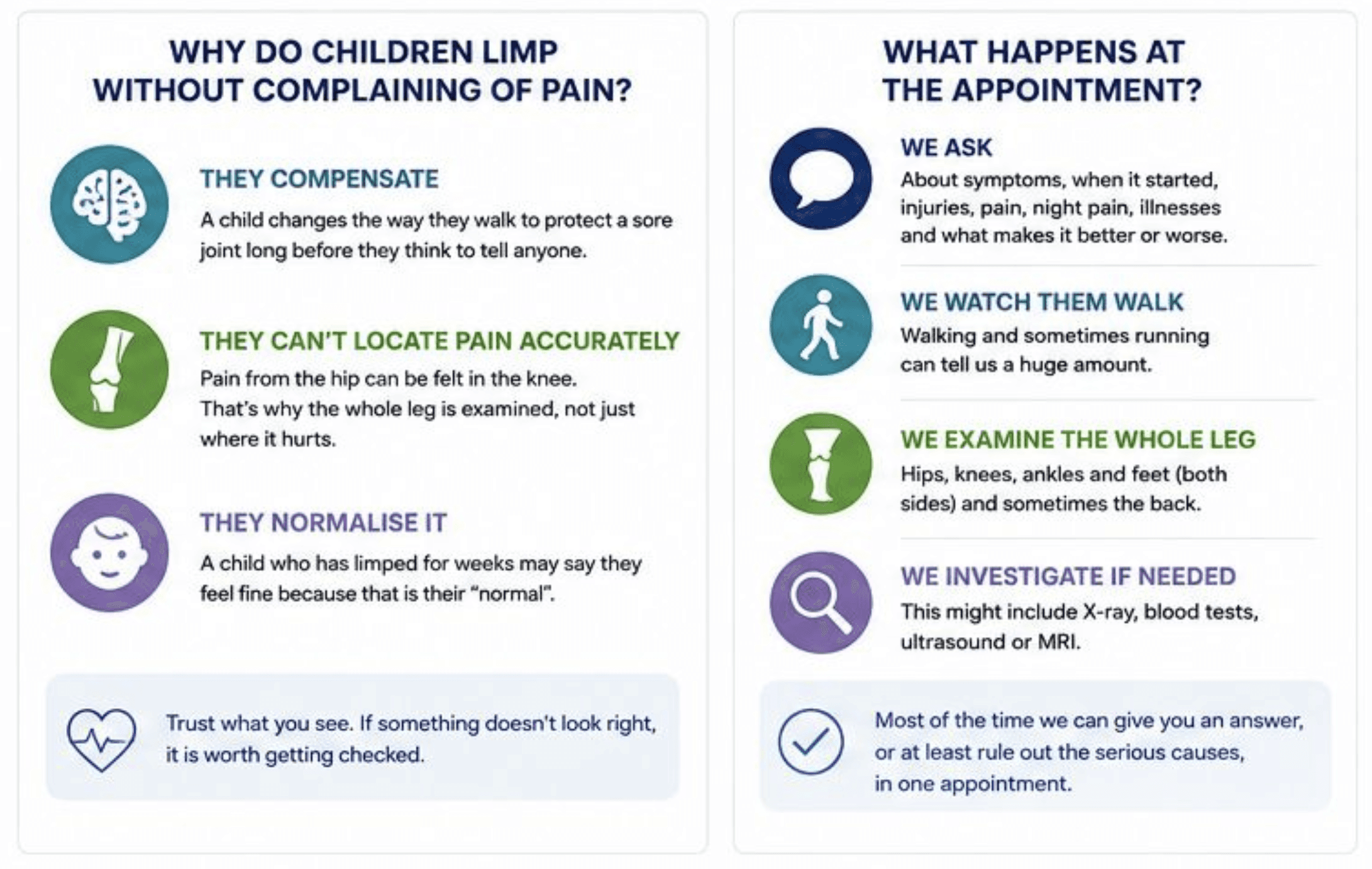
Firstly, they compensate.
A child will often unconsciously change the way they walk to protect something that is sore long before they think to tell anyone about it. Sometimes parents notice the limp before the child complains that anything hurts.
Secondly, children can be surprisingly bad at locating where pain is actually coming from.
A child may point to their knee when the problem is actually in their hip. Pain can be "referred" from one part of the leg to another.
That is why, when I assess a limping child, I examine the whole leg: the hips, knees, ankles and feet, and sometimes the back as well. Looking only at the place a child says hurts can occasionally miss the real problem.
And finally, children normalise things remarkably quickly.
A child who has been limping for some time may tell you they feel absolutely fine because, to them, that has simply become their normal way of walking.
What causes a limp at different ages?
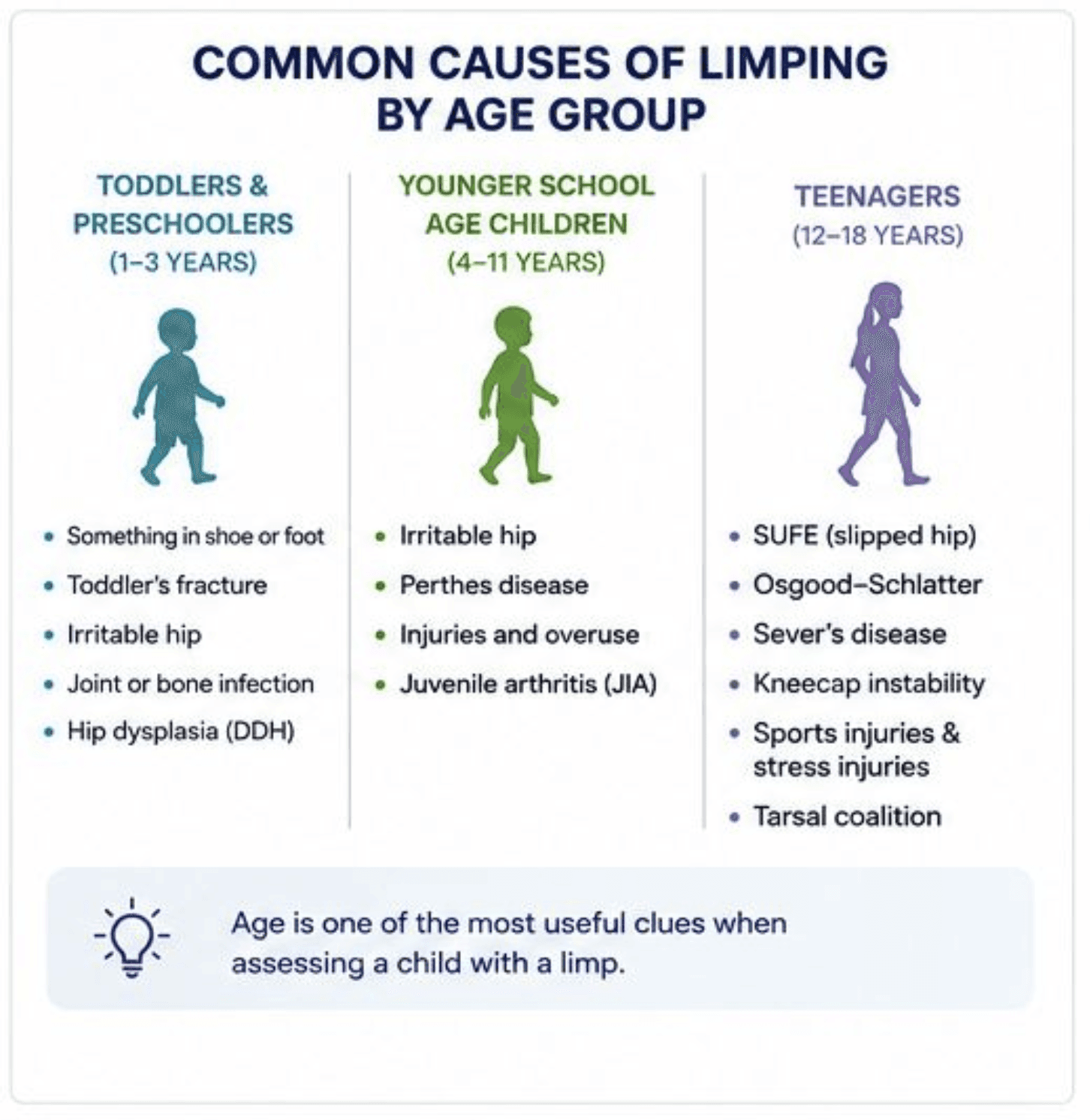
Age is one of the most useful clues.
The likely causes of a limp in a toddler are quite different from those in a fifteen-year-old.
Toddlers and preschool children
Common or important possibilities include:
Something in the shoe or foot. A splinter, verruca, blister or badly fitting shoe can be enough to alter the way a child walks. Looking at the sole of the foot and inside the shoe is always a sensible first step.
A toddler's fracture. This is a fine crack in the shin bone (tibia), often caused by a twist or fall so minor that nobody remembers seeing it happen. These are common and usually heal very well.
Irritable hip (transient synovitis). Temporary inflammation inside the hip, often occurring during or after a cold or viral illness.
Joint or bone infection. Uncommon, but important. This is why a feverish or unwell young child who suddenly refuses to walk needs urgent assessment.
Developmental dysplasia of the hip (DDH). Occasionally a hip that has been shallow since birth is only recognised when a child starts walking and develops a painless limp or waddle.
Younger school-age children
Possible causes include:
Irritable hip (transient synovitis). A common cause of limping in younger children which typically settles over a week or two.
Perthes disease. A condition affecting the ball of the hip joint. A classic presentation is a limp that comes and goes over several weeks in a child who otherwise seems completely well.
Injuries and overuse. Particularly after starting a new sport, increasing training or returning to activity after a break.
Juvenile idiopathic arthritis (JIA). This can cause morning stiffness, joint swelling or a persistent limp, sometimes with surprisingly little pain.
Teenagers
The list changes again as children approach adolescence.
Important possibilities include:
Slipped upper femoral epiphysis (SUFE). The growth plate at the top of the thigh bone slips. Importantly, teenagers with a SUFE often complain of pain in the thigh or knee rather than the hip itself, which is one reason an unexplained limp in a teenager deserves assessment.
Osgood-Schlatter disease. Pain and tenderness around the prominent bump at the top of the shin, particularly in active adolescents.
Sever's condition. Heel pain related to growth and activity in sporty children.
Kneecap instability. The kneecap may partially or completely slip out of position.
Osteochondritis dissecans (OCD). A condition where an area of bone and the overlying joint surface becomes abnormal and can sometimes become unstable.
Stress injuries and avulsion injuries. These are particularly relevant in young people doing a high volume of sport. An avulsion is an injury where a tendon pulls on its attachment to the growing bone.
Tarsal coalition. Two bones in the foot are abnormally joined, which can cause a stiff or painful flat foot and repeated ankle sprains.
The important thing is not for parents to diagnose which of these their child has. The pattern of the limp, the child's age and a careful examination usually narrow the possibilities down considerably.
Can growing pains cause a limp?
Not usually, and this is worth being clear about because "growing pains" can sometimes become a label for unexplained leg symptoms.
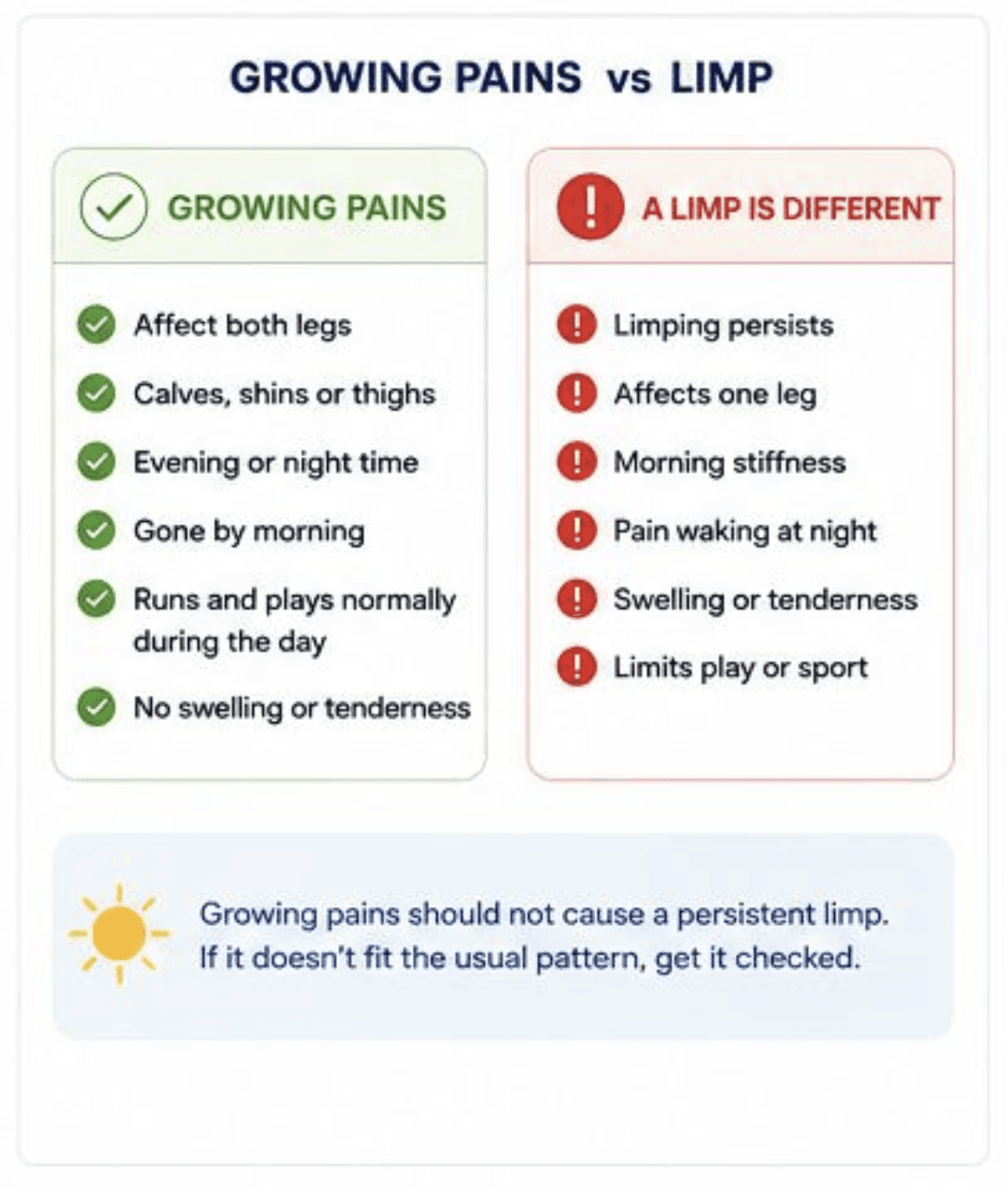
Genuine growing pains follow a fairly recognisable pattern.
They tend to:
Affect both legs
Be felt in the calves, shins or thighs
Come on in the evening or at night
Be gone by the following morning
Leave the child able to run around normally during the day
There should not usually be persistent swelling or a specific area that remains very tender.
Growing pains should not cause a persistent limp.
They also do not usually affect just one leg, cause significant morning symptoms or repeatedly stop a child taking part in normal daytime activities.
If what you are seeing does not fit that pattern, I would not simply assume that it is growing pains. It is worth having your child assessed.
Read more: Growing pains in children – when should parents worry?
One useful thing you can do before the appointment
Children have an extraordinary habit of limping all weekend and then walking perfectly normally as soon as they arrive in clinic.
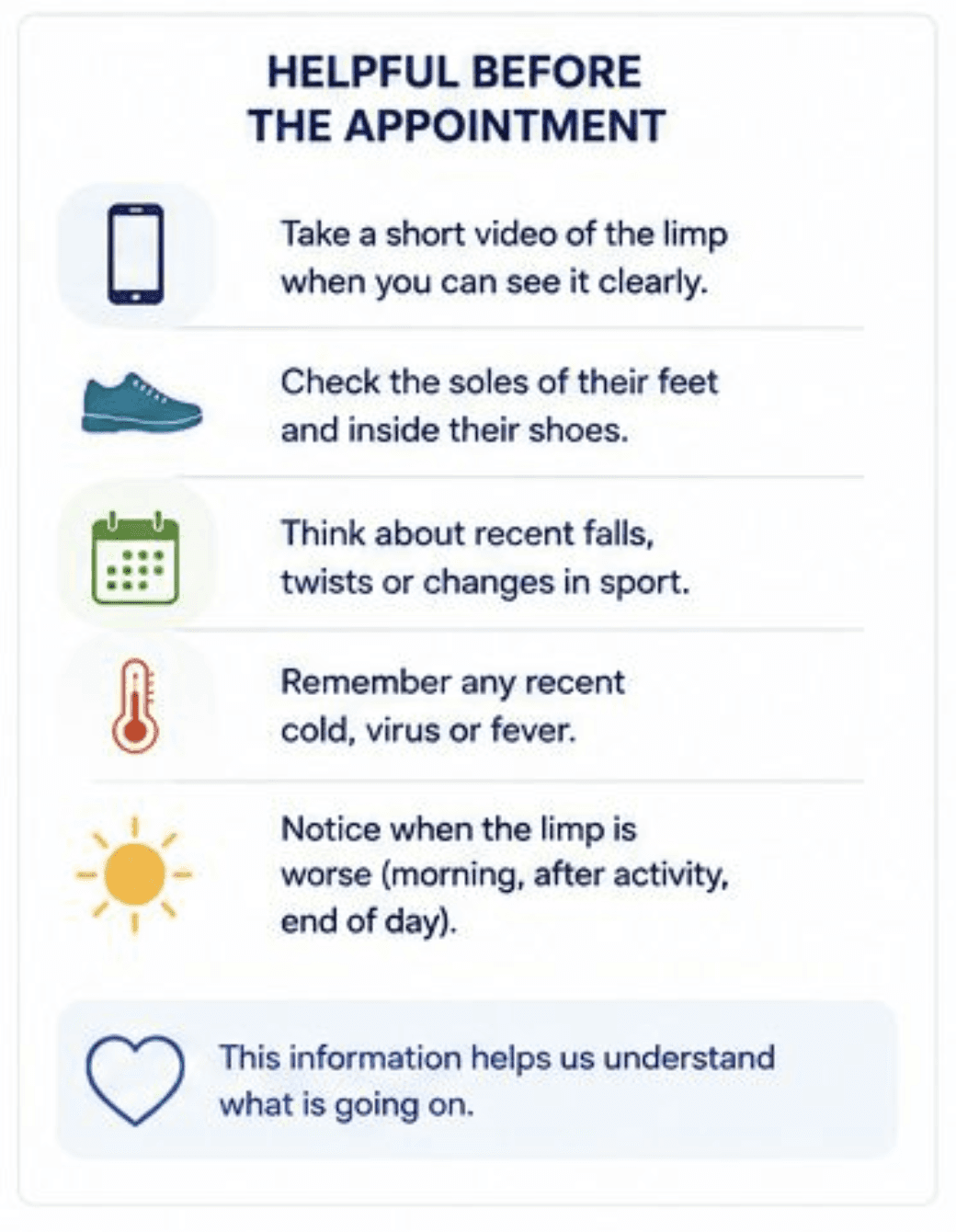
If the limp comes and goes, take a short video on your phone when you can see it clearly.
Let them walk naturally rather than asking them to demonstrate the limp.
It can also help to:
Look at the soles of their feet and inside their shoes
Think about any recent falls, twists or changes in sport
Remember whether they have recently had a cold, virus or fever
Notice whether the limp is worse first thing in the morning, after activity or towards the end of the day
A 20-second video of how your child was walking at home can sometimes tell me an enormous amount.
What happens when we see a limping child?
Usually less than parents expect, and the assessment itself is rarely frightening for the child.
We ask
When did it start? Was there an injury? Have they been unwell recently? Does anything hurt? Does pain wake them at night? Is it worse in the morning or after sport?
The story often gives us some very useful clues.
We watch them walk
This is one of the most informative parts of the whole appointment.
I will usually ask a child to walk up and down the room or corridor and, if they are happy to, perhaps run as well.
We examine the whole leg
That means both hips, both knees, ankles and feet, and sometimes the back.
In children, a problem in the hip can be felt as pain around the knee, so examining only the area that hurts can occasionally miss things.
We investigate if needed
That might mean an X-ray, blood tests if infection or inflammation is a possibility, an ultrasound to look for fluid in a joint, or occasionally an MRI if the picture is still unclear.
Not every child needs all, or even any, of these tests.
Often the history, watching them walk and a careful examination are enough to decide what needs to happen next.
In many children we can reach a diagnosis at the first appointment. If we cannot, we can usually decide whether it is safe to watch, whether further tests are needed and what should happen next.
What if the X-ray is normal but my child is still limping?
That happens, and a normal first X-ray does not necessarily mean we have reached a dead end.
Some conditions, including Perthes disease, may not be obvious on an early X-ray.
If your child's symptoms continue despite reassuring initial tests, they should be reviewed again.
Sometimes repeating an X-ray after an interval, or moving to an MRI, is a perfectly normal and sensible next step. It does not necessarily mean anything was missed or done incorrectly the first time.
A limp that persists without a diagnosis should be reviewed, not filed away.
The short version
A new or unexplained limp in a child should not simply be ignored
Most causes are minor, temporary or treatable, and most children do very well
A feverish or unwell child who refuses to stand or walk needs urgent assessment that day
A limp lasting more than a few days without a clear explanation deserves assessment
Growing pains should not cause a persistent limp
Knee pain in a child can sometimes come from the hip, so the hip needs examining too
If the limp comes and goes, a short phone video can be extremely useful
If you are worried about the way your child is walking, trust what you have noticed and have them assessed.
Most of the time the explanation is reassuring, but a persistent or unexplained limp is always worth understanding.
Worried about your child's walking?
Nev Davies is a Consultant Paediatric Orthopaedic Surgeon who assesses children and young people with walking problems, limb pain and orthopaedic conditions.
Find out more about paediatric orthopaedic appointments