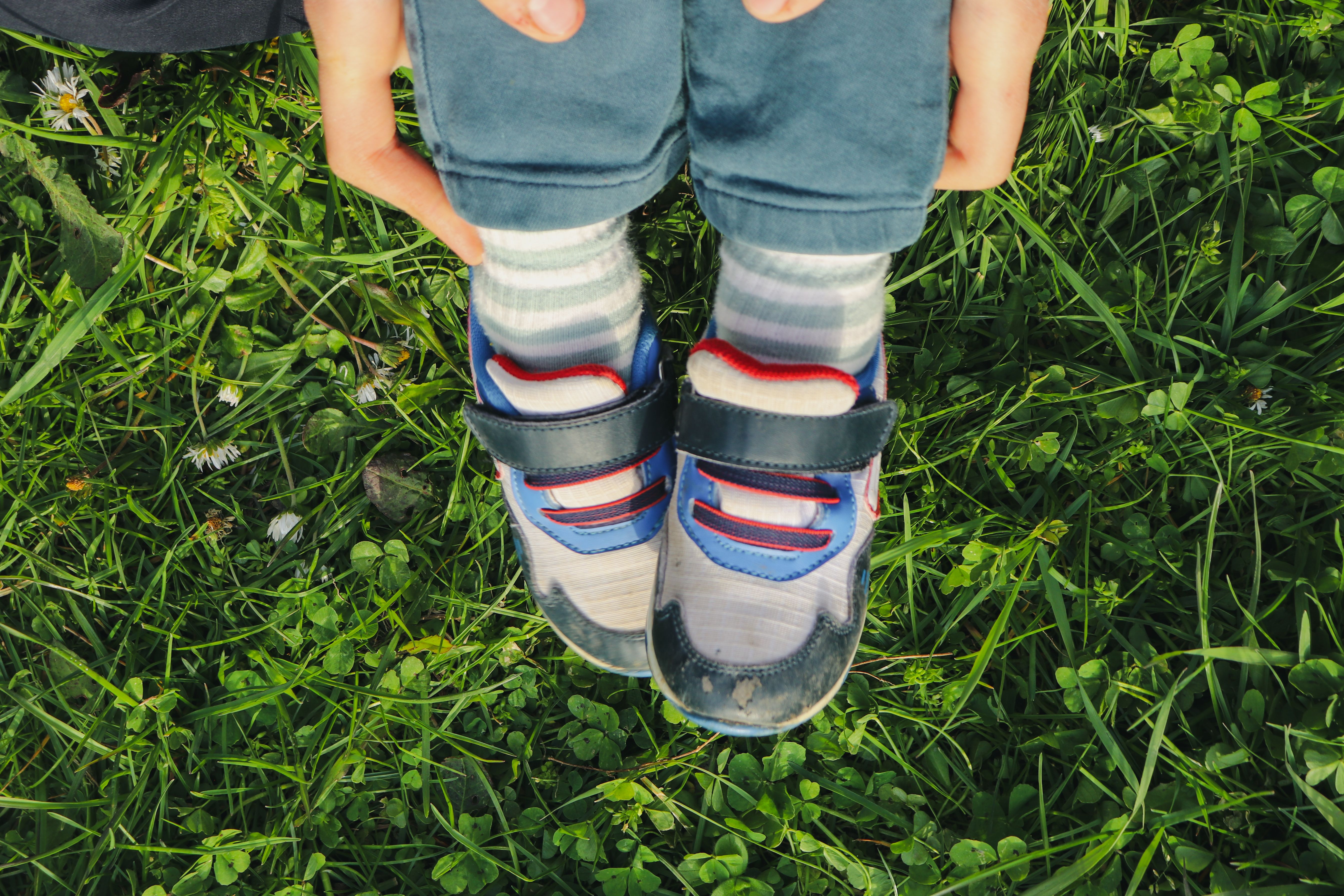
You've just noticed your child's feet look completely flat when they stand. No arch. Just sole pressed flush against the floor. And now you're wondering whether you've missed something, whether it will affect their sport, whether they need insoles, and whether you should have spotted this sooner.
Take a breath. You almost certainly have nothing to worry about.
Flat feet are one of the most common reasons parents are referred to a children's orthopaedic specialist, and the vast majority of those consultations end with the same message: this is normal, your child is fine, and there is nothing you need to do.
But there are exceptions, and they matter. Here's how to tell the difference.
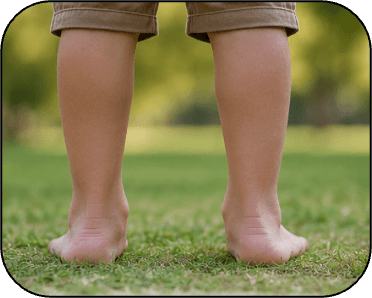
Flat feet in children are extremely common and in most cases are a completely normal part of development.
What Exactly Are Flat Feet?
Flat feet, known medically as pes planus, simply means the arch on the inner side of the foot is low or absent when the child is standing. Instead of the typical upward curve along the inside of the foot, the whole sole makes contact with the ground.
What most parents don't realise is that almost every child is born with flat feet. At birth, and for the first few years of life, the foot is largely made up of cartilage rather than solid bone, and there is a fat pad under the arch that fills the space and makes the foot look completely flat. This is entirely normal.
As a child grows, the bones harden, the fat pad is gradually absorbed, the muscles of the foot strengthen, and the ligaments tighten. The arch begins to emerge. It develops gradually across the first decade, with most children showing a clearly visible arch by around the age of eight, though some take longer still, and for a small number, a low or flat arch is simply their anatomy for life. That too is completely compatible with a healthy, active, pain-free existence.
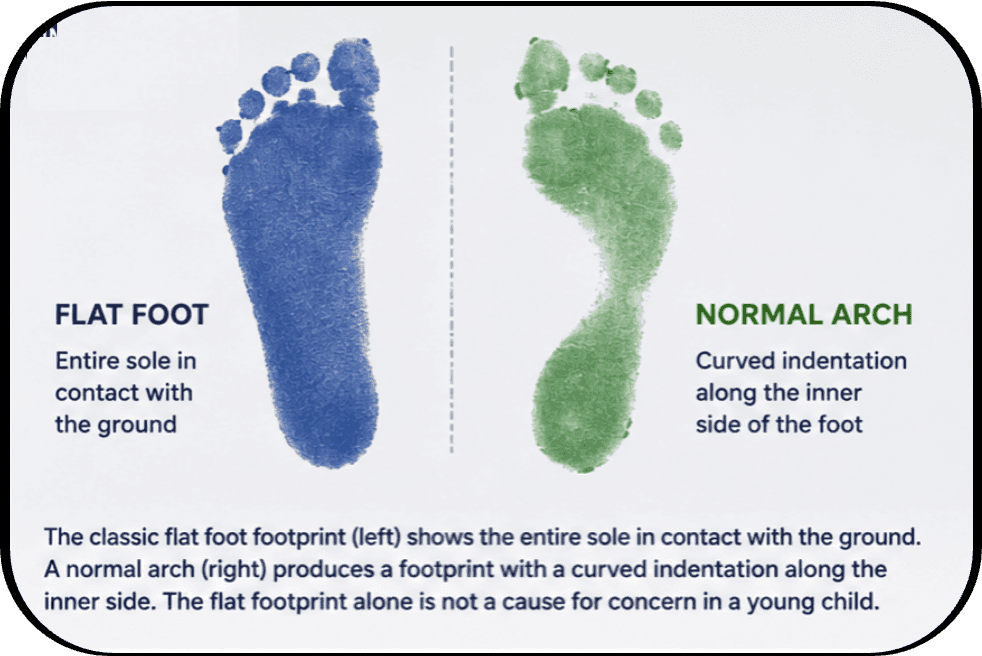
The Two Types of Flat Feet in Children: Why the Difference Matters
Not all flat feet are the same, and understanding the distinction is the single most important thing you can do when assessing your child's feet.
Flexible Flat Feet
This is by far the most common type, accounting for the overwhelming majority of cases seen in children.
The key feature is this: the arch disappears when the foot bears weight, but reappears when the child sits down with their feet off the ground, or when they stand on tiptoe. The foot is flexible. The muscles, tendons, and joints are all functioning normally. The arch is there, it is just not holding itself up under load, which in a young child is completely expected.
Flexible flat feet are a normal variation. They run in families. They are not a deformity. And in most cases, they cause no pain, no functional limitation, and need no treatment whatsoever.
Rigid Flat Feet
In rigid flat feet, the arch is absent whether the foot is bearing weight or not. You ask the child to sit down and the foot is still flat. You ask them to rise on tiptoe and the foot still won't form an arch, or the movement is limited and uncomfortable.
This is a different situation. Rigid flat feet are less common and more likely to have an underlying cause that warrants investigation. One of the most important of these is tarsal coalition, a condition where two or more of the small bones in the foot are abnormally fused or joined together, preventing normal movement. Tarsal coalition often comes to light in early adolescence when it begins causing pain, stiffness, and repeated ankle sprains.
Rigid flat feet should always be assessed by a specialist.
Will My Child's Flat Feet Cause Problems?
For flexible flat feet, in most cases, no. Many children, teenagers, and adults with flat feet are completely pain-free, play sport at the highest level, and live without any foot-related difficulties throughout their lives. Some of the world's finest athletes have flat feet.
That said, some children with flat feet do develop symptoms, and it is worth knowing what to look out for.
Pain or aching in the feet, heels, or ankles after activity is the most common complaint. Some children describe their legs feeling tired or heavy more quickly than their peers. Others develop pain further up the kinetic chain, in the knees or even the lower back, as the altered foot posture can sometimes affect the mechanics of the whole limb.
Do Flat Feet Need Treatment?
Here is something important that isn't always communicated clearly: for the majority of children with flexible, pain-free flat feet, no treatment is needed. Not insoles, not special shoes, not exercises.
There is no robust clinical evidence that putting insoles into a pain-free child's shoes will cause an arch to develop. The arch develops on its own timetable, or it doesn't, and an insole in an asymptomatic child is unlikely to change that outcome.
Where treatment becomes genuinely useful is when flat feet are causing pain or affecting function. In those cases, the options include the following.
Physiotherapy targeting the muscles of the foot, lower leg, and hip can make a substantial difference. Tight calf muscles are one of the most common things we find in a flat foot that has turned sore, and simple calf and heel-cord stretches are often a central part of settling it down. The foot is not an isolated structure and its posture is influenced by the strength and alignment of everything above it. A well-designed exercise programme can improve mechanics, reduce pain, and build resilience.
Supportive footwear with a good heel counter and arch structure can reduce fatigue and discomfort during activity. This is not the same as a rigid orthotic. It simply means a well-made shoe rather than a flimsy one.
Orthotic insoles, custom or off-the-shelf, can be helpful in symptomatic cases. They don't build an arch, but they can reduce the load on painful areas, improve alignment during activity, and make a meaningful difference to day-to-day comfort.
For rigid flat feet or those caused by an underlying structural problem such as tarsal coalition, further investigation with X-ray or MRI is usually needed before a treatment plan can be made, and in some cases surgical treatment is appropriate and can produce excellent results. It is worth saying that surgery is rarely the answer here: fewer than one in ten children with flexible flat feet ever become surgical candidates.
When Should I Get My Child's Flat Feet Checked?
Most children with flat feet don't need a referral. But there are specific circumstances where a specialist opinion is worthwhile, and these are the situations I would encourage you not to sit on.
Seek a specialist assessment if the foot stays completely flat even when your child stands on tiptoe, at any age, as this points to a stiff (rigid) flat foot rather than the common flexible type. And if your child is approaching eight to ten with no arch beginning to form at all, that is a sensible point to have things reviewed.
Seek an assessment if your child is experiencing pain. Pain in the feet, heels, ankles, knees, or lower back that you can connect to activity, or that is getting worse over time, is not something to dismiss. It may well be manageable with simple measures, but it deserves a proper look.
Seek an assessment if one foot is significantly flatter than the other. Asymmetry in any aspect of a child's musculoskeletal system is always worth investigating, as it may point to an underlying cause.
Seek an assessment if your child is avoiding activity, dropping out of sport they previously enjoyed, or complaining that their legs feel tired much sooner than their peers. These functional limitations matter, and they often respond well to treatment.
Seek an assessment if your child can't rise onto tiptoe comfortably, or has significant stiffness or pain around the ankle and foot.
And finally, seek an assessment if something simply doesn't feel right to you as a parent. A clinical opinion is never wasted.
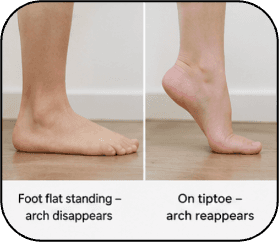
One of the most useful things you can do at home is ask your child to stand on their tiptoes. If an arch appears, the flat feet are almost certainly flexible, which is the benign and common type. If no arch appears, or if tiptoe standing is difficult or painful, that is a reason to seek assessment.
A Note on Genetics
Flat feet run strongly in families. If you or your partner have flat feet, the chances are higher that your child will too. This is not a failure of parenting, nutrition, or footwear choices. It is simply inheritance, and it is one of the most common reasons for the referrals I see.
Knowing this can also help with siblings. If one child has symptomatic flat feet, it is worth keeping an eye on the others.
The Bottom Line
Flat feet in children are extremely common, usually completely normal, and in most cases require nothing more than reassurance and a watch-and-wait approach. The arch develops on its own in the majority of children, and even those who carry a flat foot into adulthood very often live entirely pain-free active lives.
But if your child is well into the first decade with no arch forming at all, if they are in pain, if one foot is noticeably worse than the other, or if a rigid flat foot is limiting their movement, those are the situations that deserve a proper assessment.
Early diagnosis gives you more options. And the earlier any underlying cause is identified, the better the outcome tends to be.