What age do most babies start walking?
Most children take their first independent steps somewhere between 12 and 15 months.
The full normal range is wider than that. Some children walk at 9 months. Some are still not walking at 17 months and turn out to be completely fine. Large studies looking at thousands of children put the average at around 12 to 13 months, but an average is exactly that: half of all children are later than it, by definition.
This is why I am wary of single numbers. If you take one thing from this blog, take the range and the 18 month threshold, not the average.
Not walking at all by 18 months needs a prompt check with your GP. This is the one age where "let's wait and see" is not the right answer.
Losing a skill your child already had, at any age, needs urgent assessment. A child who was walking and has stopped should be seen quickly.
Everything else in between is usually just your child's own timetable.
If your child is 13, 14 or 15 months and not yet walking, that is common, it is normal, and it is not something I would be worried about on its own. Here is the detail.
My baby is 15 months and not walking. Is that normal?
Yes, in most cases.
At 15 months, a child who is pulling to stand, cruising along the sofa, squatting and standing back up, and generally getting stronger every week is a child who is on their way. The steps will come.
What I look at in clinic is not the date, it is the trajectory. Is your child steadily gaining skills? Are they using both sides of their body equally? Are they getting stronger and more confident rather than staying still?
A child who is progressing through the stages is telling you far more than the number on the calendar.
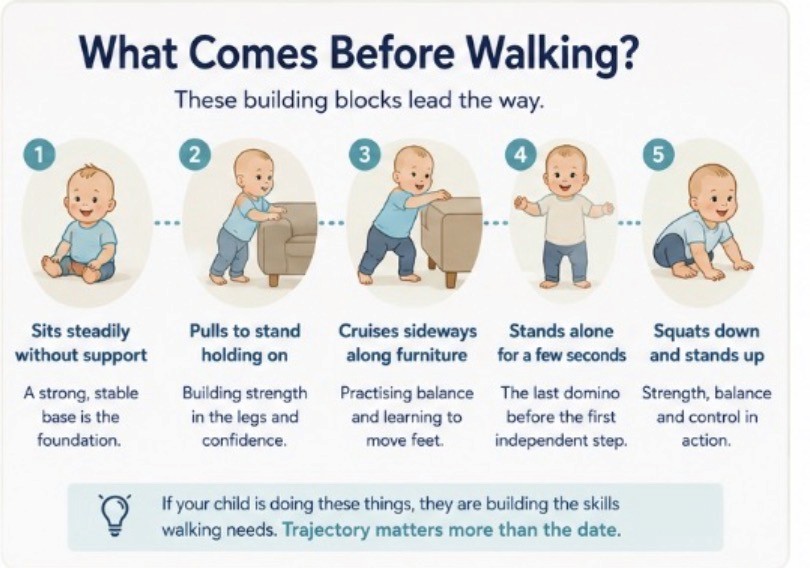
What comes before walking?
The building blocks matter more than most parents realise:
Sitting steadily without support
Getting themselves up to standing while holding on
Cruising sideways along furniture
Standing alone for a few seconds without holding
Squatting down and getting back up again
If your child is ticking these off, they are building the strength, balance and confidence walking needs. Standing alone unsupported is usually the last domino before the first step.
Does bottom shuffling mean my child will walk late?
Bottom shufflers are one of the most common reasons parents end up in my clinic, and they are almost always fine.
Some children never crawl on all fours at all. They sit up and scoot along on their bottom, often at impressive speed, and they tend to walk roughly a month later than children who crawl conventionally. That is it. A month.
Crawling is not a compulsory stage. In some parts of the world a substantial proportion of babies skip it altogether and go straight from sitting to walking, with no ill effects whatsoever. If your child has found a way to get across the room, they have solved the problem. They just solved it differently.

Is walking age genetic?
Partly, yes, and there is now good evidence for it.
A large study published in 2025 looked at the genetics of walking age in over 70,000 infants and found that around a quarter of the variation between children comes down to common genetic differences. That is a similar contribution to genetics we see in traits like height.
In practical terms: if you or your partner were late walkers, there is a reasonable chance your child will be too. It is worth asking the grandparents. Parents often find that one conversation more reassuring than anything I can say in clinic.
Does it matter if my child walked late?
This is my favourite finding in the whole area, because it takes the pressure off completely.
When researchers look at how well a toddler walks, the best predictor is not the age they started. It is how long they have been walking. A child who started at 10 months but spends most of the day in a buggy or a highchair may well be a less confident walker than a child who started at 14 months and has been let loose on the floor.
Time on their feet is what builds the skill. Not the start date.
So if your child is a late starter, the useful response is not worry, it is floor time. Safe space, bare feet where possible, and plenty of opportunity to practise.
Does tummy time or sleeping position affect it?
A little, and only temporarily.
Since babies have been placed on their backs to sleep (which has saved an enormous number of lives and should absolutely continue), we have seen some gross motor milestones arrive slightly later on average. The effect is real but small, and it washes out. The vast majority of children still walk well within the normal range.
Tummy time while your baby is awake and supervised is the sensible counterbalance, and it helps build the neck, shoulder and trunk strength that everything else is built on.

Do children walk earlier in some countries?
They do, and it is a good reminder that there is no single correct trajectory.
In cultures where babies are routinely massaged, stretched and physically exercised by their carers, and where floor time is the norm, children tend to walk noticeably earlier than Western averages. Where babies spend more time contained in seats, playpens and buggies, walking tends to come later.
The message for parents is not that you are doing it wrong. It is that opportunity to move matters, and it is one of the few parts of this you can actually influence.
When should I actually worry?
Get your child looked at, either through your GP or directly with a children's orthopaedic specialist, if:
Your child is not walking independently at 18 months. This is the one to act on rather than wait out.
Your child has lost a skill they previously had. A child who was walking, cruising or standing and has stopped needs to be seen urgently, at any age. Go via your GP for this one, as it needs a broad assessment first.
One side of the body is clearly different from the other. Always using one hand, dragging one leg, or a persistent lean to one side.
Your child feels very stiff or very floppy when you handle or lift them. Again, your GP is the right first port of call here.
Progress has stalled completely and your child has gained nothing new for several months.
Your child walks only on their toes and cannot get their heels down. (I have written separately about tiptoe walking in children.)
None of these mean something is seriously wrong. They mean it is worth a proper look rather than a Google search at midnight.
You do not always need a referral to see me. Many parents come directly, and if it turns out to be nothing (which it very often is), you will have got a clear answer from someone who does this every week.
The bottom line
Walking is one of the noisiest milestones there is, because it is visible, it gets compared at every baby group, and it arrives on wildly different dates for perfectly healthy children.
Most children walk between 12 and 15 months. Some take until 18. What matters far more than the date is that your child is progressing, using both sides equally, and gaining skills rather than losing them.
And once they do go, you will spend the next decade wishing they would sit still.