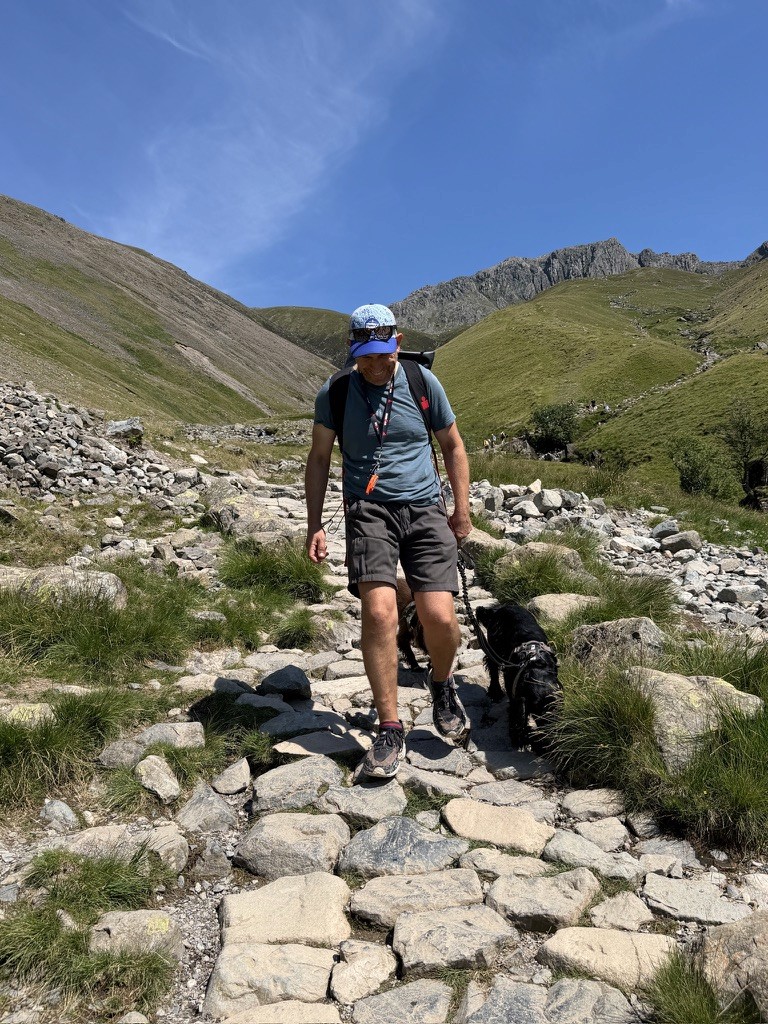
Last week I was in the Lake District with Lauren, the boys and the dogs, walking down from Scafell Pike on a perfect blue-sky day. The path down into Wasdale is a long, rocky staircase, and about halfway down I could start to feel it a bit through the front of my knees. On the way up, people talk about the view. On the way down, they talk about their knees.
Fast forward to Monday morning and I'm standing at the top of the escalator on my commute into London, watching people make the same quiet calculation: stairs or escalator? And for a lot of people, the honest answer is that going down is the problem. Down the mountain, down the stairs at the station, down to the platform. Up feels fine. Down hurts.
If that sounds familiar, this blog is for you. It is one of the most common things I hear in clinic from active adults in their 40s, 50s and 60s, and the good news is that in most cases it is very fixable.
Scafell Pike descent
Why does going down hurt more than going up?
It seems backwards, doesn't it? Going up is the hard work, so surely that should be the painful bit.
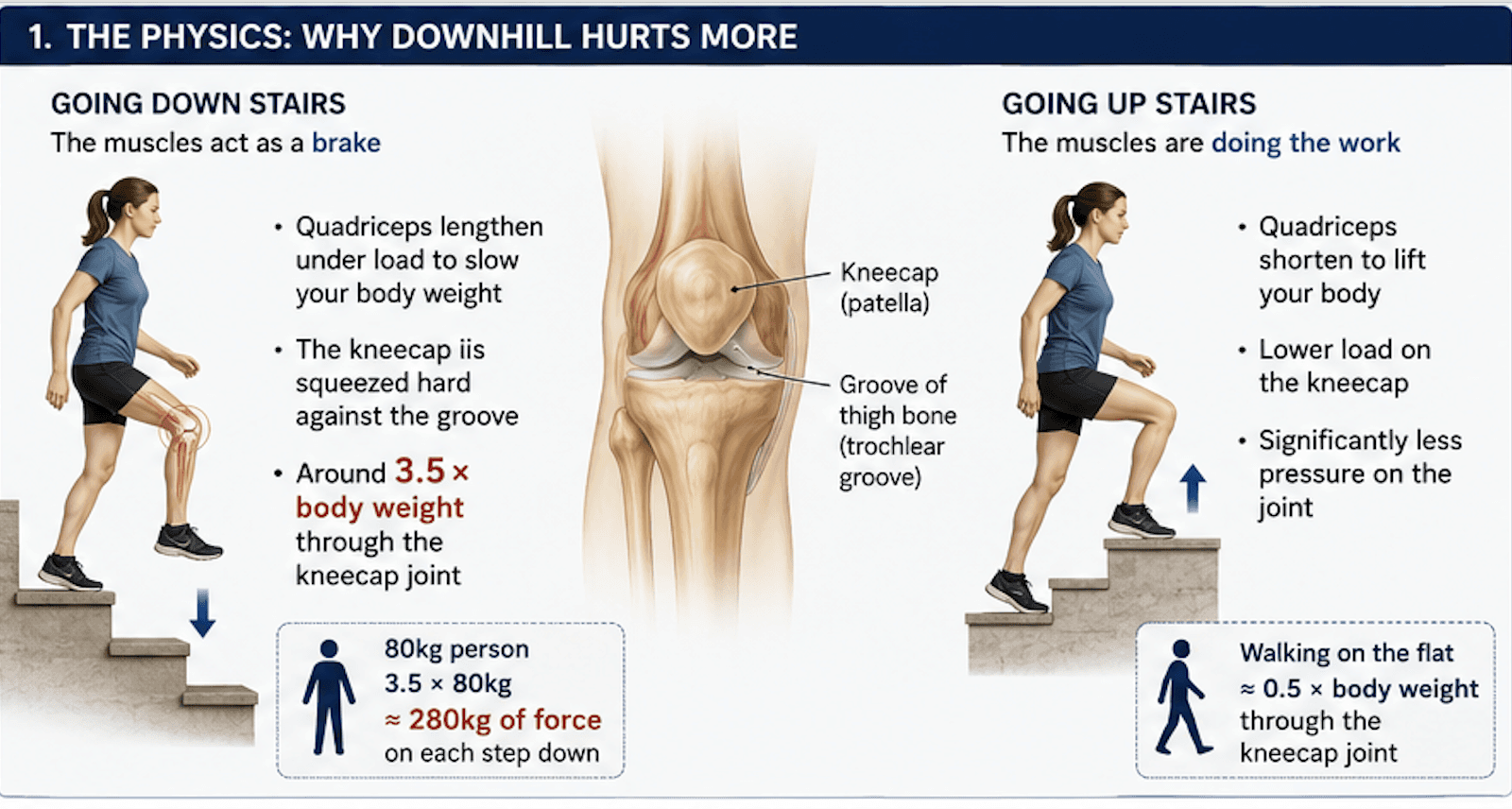
The answer is in the physics. When you walk down stairs or downhill, your thigh muscles (the quadriceps) have to act as a brake. They lengthen under load to slow your body weight as you drop onto a bent knee. That braking action squeezes the kneecap (the patella) hard against the groove of the thigh bone it glides in.
The numbers are striking. Walking on the flat puts roughly half your body weight through the kneecap joint. Coming down stairs puts around three and a half times your body weight through it. So an 80kg person is asking a joint surface the size of a couple of postage stamps to handle about 280kg of force, step after step after step.
Going up uses the same muscles, but they are shortening rather than braking, and the load on the kneecap is significantly lower. That is why so many people can climb happily and then wince all the way down.
What is actually causing the pain?
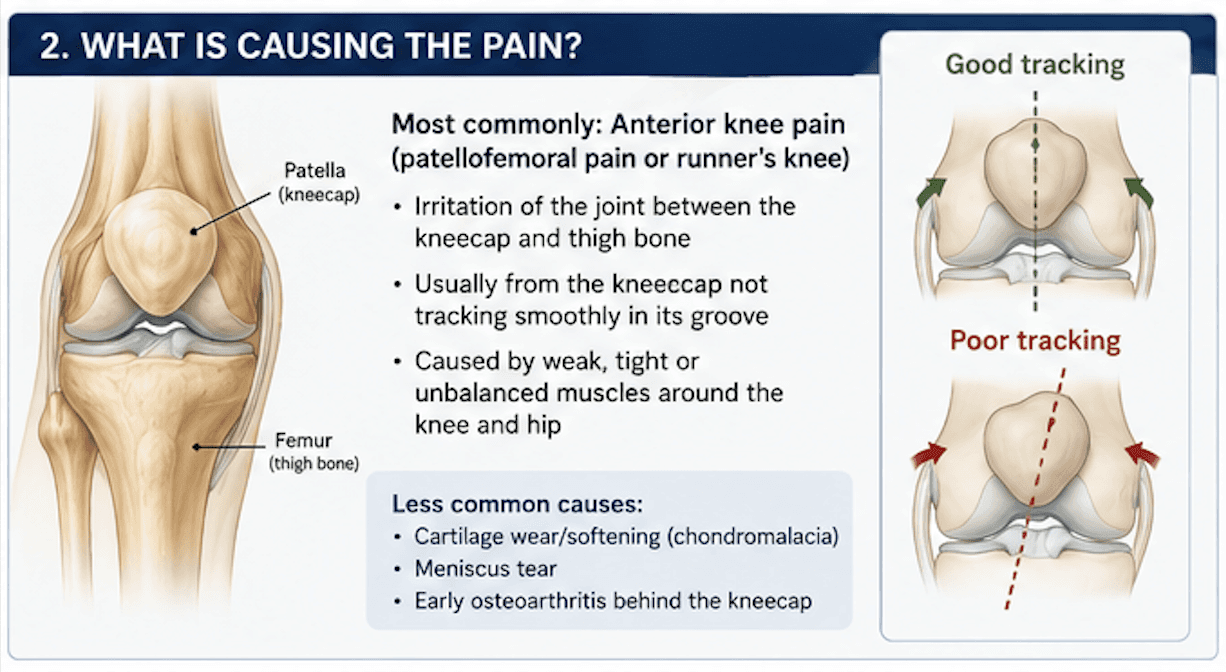
The most common culprit by a long way is anterior knee pain, also called patellofemoral pain or runner's knee (although you certainly don't need to be a runner to get it). It is an irritation of the joint between the kneecap and the thigh bone, usually felt as an ache or sharp catch at the front of the knee, sometimes with a grinding or clicking sensation.
It usually happens when the kneecap isn't tracking smoothly in its groove. The kneecap is steered by the muscles around it, particularly the quadriceps and the muscles around the hip. If those muscles are weak, tight or out of balance (very common in people who sit at a desk all week), the kneecap gets pulled slightly off line, and those big downhill forces start to irritate the joint.
There are a couple of less common causes worth knowing about. Softening or wear of the cartilage behind the kneecap (chondromalacia) can cause very similar symptoms, and in the over-40s a tear of the meniscus (the knee's shock-absorbing cartilage) can also show up as pain on stairs. Early osteoarthritis behind the kneecap sits in this family too. This is why it is worth getting a proper diagnosis if the pain persists, because the treatment paths are different.
Is it damaging my knee?
Here is the reassuring part. For the vast majority of people, pain at the front of the knee on stairs is a sign of overload and irritation, not damage. The joint is complaining, not crumbling.
Knees are built for load. Cartilage actually needs regular loading to stay healthy, in the same way muscles need exercise. The problem is rarely the stairs themselves. It is usually that the muscles controlling the kneecap aren't strong enough for the job we are asking them to do.
Which leads to the slightly surprising prescription.
What actually helps?
Not avoiding stairs. I know that is what your knee is telling you to do, but in most cases avoidance makes the problem worse, because the muscles get weaker and the knee copes less well with the loads it can't avoid.
The evidence for treating anterior knee pain points firmly at strengthening, particularly the quadriceps and the muscles around the hip. The stronger and better balanced those muscles are, the better the kneecap tracks and the more comfortably it handles load. This is where your commute stops being the enemy and becomes the treatment:
Take the stairs, but take them well. Use the whole foot on the step, keep your knee tracking over your toes rather than collapsing inwards, and use the handrail if you need to take some load off while things settle.
Build up gradually. If two flights hurt, start with one and add more as it settles. Little and often beats heroic and occasional.
Add two simple exercises at home. Sit-to-stand from a chair without using your hands, and step-ups onto the bottom stair. Two or three sets of each, a few times a week, is a genuinely effective starting point for most people.
Look after the basics. Decent cushioned shoes for the commute, keeping your weight in a healthy range (every extra kilo is three and a half extra kilos on the kneecap coming downstairs), and if you walk downhill regularly, poles are not cheating.
Get the hips involved. Weak gluteal muscles are one of the commonest findings in people with this problem. Side-lying leg raises and single-leg balance work pay off more than people expect.
A good physiotherapist can tailor all of this properly, and for straightforward anterior knee pain, physiotherapy-led strengthening is the first-line treatment. Surgery is very rarely needed.
When should I actually worry?
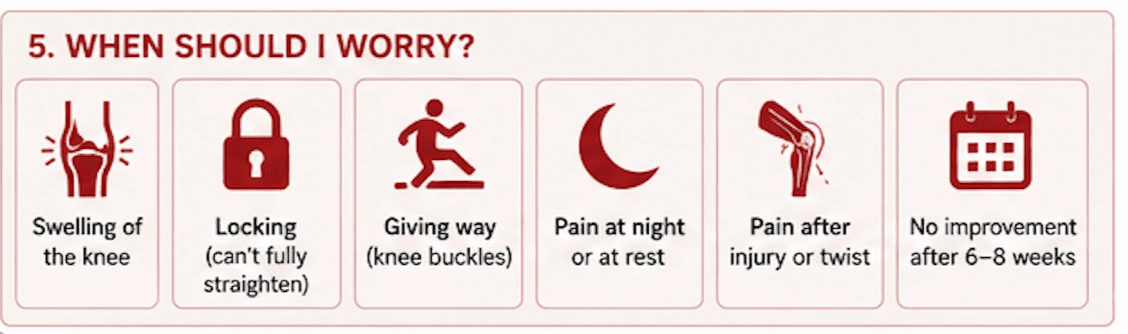
Most stair-related knee pain settles with the approach above. But there are some signs that mean the knee should be looked at properly rather than managed at home:
Swelling of the knee, especially if it comes on quickly or keeps returning
Locking, where the knee gets stuck and won't fully straighten
Giving way, where the knee buckles or feels like it will not hold you
Pain that wakes you at night or is there at rest
Pain following an injury or a twist
Pain that has not improved after six to eight weeks of sensible strengthening
None of these automatically mean something serious, but they do mean the diagnosis needs confirming, sometimes with a scan, so the right treatment can be started.
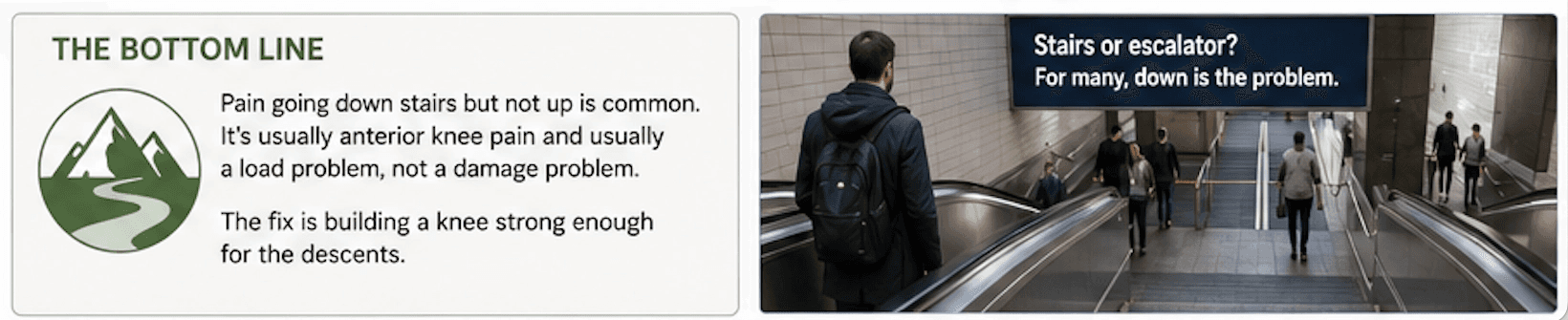
The bottom line
Pain going down stairs but not up is common, it is usually anterior knee pain, and it is usually a load problem rather than a damage problem. The fix, counterintuitively, is rarely rest. It is building a knee strong enough for the descents, whether that is the staircase at the station or the path down from Scafell Pike.
If your knees are complaining on the way down and it is not settling, or any of the warning signs above ring true, it is worth getting it properly assessed. A clear diagnosis takes the guesswork (and the worry) out of it, and gets you back to taking the stairs two at a time.
To book an appointment, contact my practice manager Debbie on 07305 097137 or nevdavies.secretary@gmail.com, or visit nevtheknee.co.uk