It is a scene I see most weeks in clinic. Someone sits down, we look at their X-rays together, and before I have said very much at all, a folded piece of paper comes out of a pocket or handbag. It is a list of questions, often written over several evenings, sometimes with a partner’s additions in different handwriting.
Over the years I have noticed that these lists are remarkably similar. The same six questions come up again and again, and they are exactly the questions people type into Google late at night when their knee is keeping them awake. So here are my honest answers.
A knee replacement is one of the most successful operations in modern surgery, but it is a big operation with a real recovery, and it is not right for everyone. I would rather you heard the realistic version from me now than a glossy one from somewhere else.
The Bottom Line
- Recovery: most people walk the day after surgery, go home after one or two nights and are doing most everyday things by around three months. Full recovery takes up to a year.
- Pain: the first two weeks are the hardest. Pain is often worse at night, which is common and usually settles.
- How long it lasts: around 9 in 10 total knee replacements are still working at 20 years, and around 8 in 10 at 25 years.
- Driving: most people drive again at around six weeks, once they can do an emergency stop safely.
- Age: there is no age that is automatically too young or too old. Timing is about how much your knee is affecting your life.
- Afterwards: walking, hill walking, golf, cycling and gentle skiing are all possible. Jogging and more vigorous sport usually are not. Kneeling is very possible with practice.
1. How long does it take to recover from a knee replacement?
This is the question I am asked most, and the honest answer is: longer than most people expect, but with steady progress along the way. Recovery is not one event, it is a series of milestones.
| When | What to expect |
|---|---|
| Day of surgery or the next day | Up and walking with a physiotherapist, using a frame or crutches |
| 1 or 2 nights | Most of my patients go home once they are safe on stairs and their pain is controlled |
| Weeks 1 to 2 | The hardest stretch: swelling, stiffness and sore nights. Your exercises matter most here |
| Weeks 2 to 6 | Moving from two crutches to one, then a stick, and walking a little further each day |
| Around 6 weeks | Many people are driving and back to desk-based work. Usually your first review appointment |
| Around 3 months | Most everyday activities without much thought, and pain much reduced |
| 6 to 12 months | Swelling and warmth gradually settle. The knee keeps improving for up to a year |

Knee replacement recovery is a series of milestones, not a single finish line.
The biggest thing in your control is the exercise programme in the first six to eight weeks. Getting the knee fully straight early is particularly important, because a knee that stiffens in a bent position is hard to recover later. A partial knee replacement usually recovers faster than a total one.
2. How painful is a knee replacement, and why is it worse at night?
I won’t pretend it doesn’t hurt. A knee replacement is a big operation and the first couple of weeks are uncomfortable for nearly everyone. Modern anaesthetic techniques and a planned painkiller routine make it far more manageable than it was a generation ago, and the pain improves week by week.
One of the things patients tell me most often in the early weeks is that their knee is just about fine during the day and miserable at night. There are several reasons for this:
Fewer distractions. During the day you are moving and busy. In a dark, quiet bedroom, the knee is all you notice.
Swelling builds up. After a day on your feet, the knee is often at its most swollen by the evening.
Stiffness. Lying still for hours lets the knee stiffen, so the first movement in the night can be sharp.
Painkillers wear off. A dose taken in the evening may run out in the early hours.
Poor sleep turns the volume up. Tiredness makes pain feel worse, and pain makes sleep worse.
What helps with knee replacement pain at night?
Time your painkillers so a dose is due around bedtime, following your hospital’s advice.
Ice (or a cold therapy device) and raising the leg in the evening to bring the swelling down.
Avoid a pillow under the knee. It feels comfortable but encourages the knee to stiffen bent.
If you sleep on your side, a pillow between your knees can help.
If you wake stiff, a few gentle exercises in bed often help more than lying still.
For most people, night pain eases over the first six to twelve weeks. If it is getting worse rather than better, tell your surgical team.
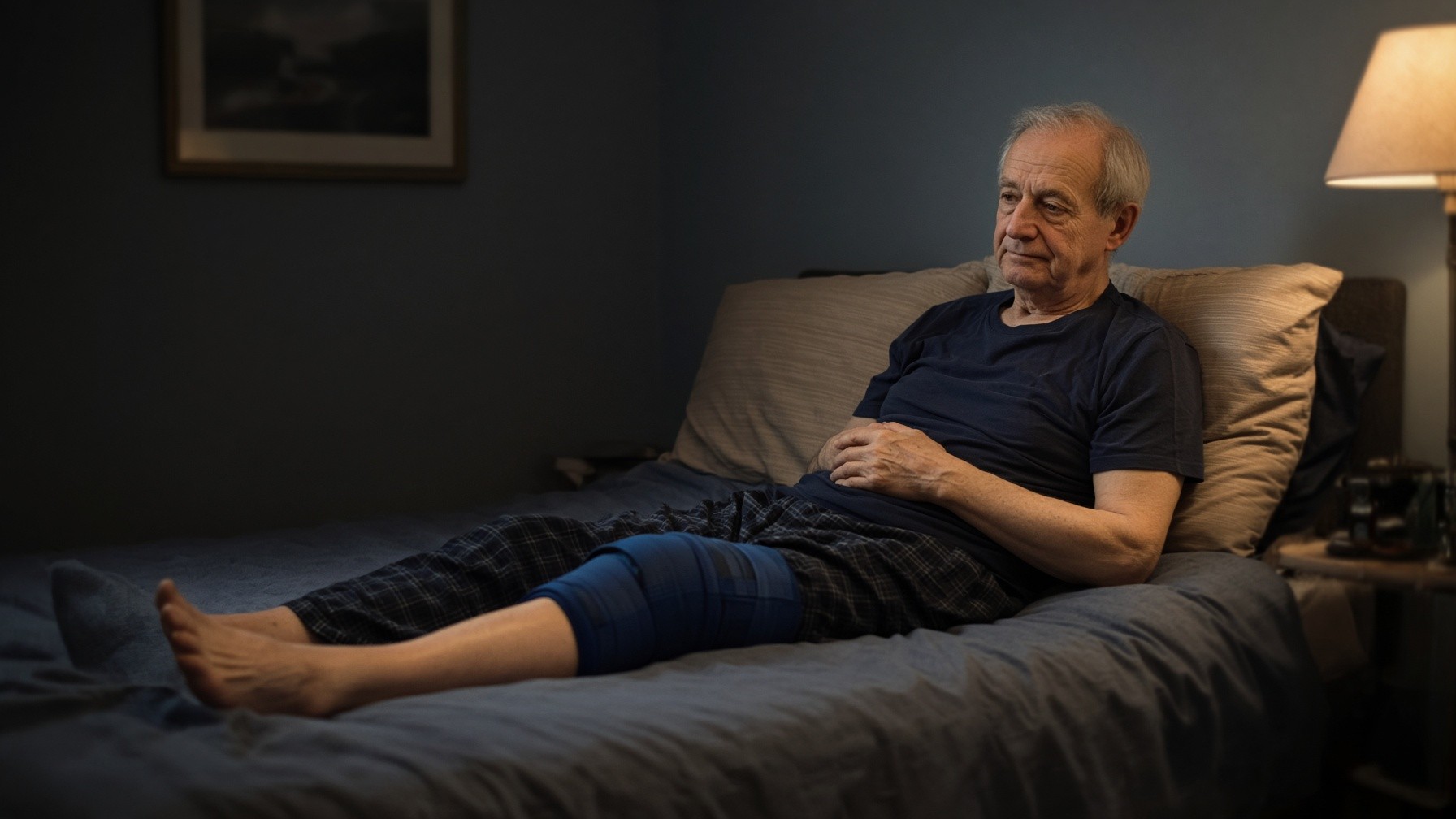
Night pain is one of the most common complaints in the first few weeks.
It is also fair to tell you that while around 8 in 10 people are satisfied with their knee replacement, roughly 1 in 5 have some ongoing pain or are unsure about the result. That is one reason I take time to make sure surgery is the right step, and why I track every patient’s outcome scores before and after surgery.
3. How long does a knee replacement last?
The best evidence we have comes from a large study published in The Lancet in 2019, which pooled data from national joint registries around the world. It found that around 90% of total knee replacements were still in place at 20 years, and around 82% at 25 years. Partial knee replacements did a little less well, with around 70% still working at 25 years.

Those figures come from operations carried out 20 to 25 years ago. Implants and techniques have improved since, so knees put in today may well do better.
When a replacement eventually needs a second operation (a revision), it is usually because of wear of the plastic bearing, loosening, infection, or stiffness or instability. Age matters too: a 55 year old will put many more years of use on their knee than an 80 year old, so they are more likely to need a revision at some point in their lifetime. Every knee replacement I carry out is recorded on the National Joint Registry, which tracks how implants and surgeons perform over time.
4. When can I drive after a knee replacement?
NHS advice is to wait at least six weeks after a total knee replacement and three weeks after a partial one. In practice, the test is simple. You need to be able to get in and out of the car comfortably, be off any painkillers that affect your concentration, and be able to do an emergency stop without hesitating.

In my own practice, most people are back driving at around six weeks, provided they can do a safe emergency stop. If your left knee was replaced and you drive an automatic, you may be ready sooner, but check with your surgical team first. Always tell your insurer that you have had surgery before you drive again.
When can I go back to work after a knee replacement?
It depends on your job. Many people in desk-based roles go back at around six weeks, often on a phased return. More physical jobs usually take 6 to 12 weeks or longer.
5. When is the right time for a knee replacement, and am I too young?
There is no magic age. I see people in their fifties who need a new knee and people in their eighties who do brilliantly. NICE guidance is clear that age, weight, smoking and other health conditions should not on their own stop someone being referred for a joint replacement, although they do affect the risks and are part of the conversation.

The right time is less about your X-ray and more about your life. These are the questions I find most useful:
Is your knee pain waking you at night?
Has the distance you can walk shrunk?
Have you stopped doing things you love because of your knee?
Have you genuinely tried physiotherapy, weight management, painkillers and injections?
Arthritis on an X-ray does not automatically mean surgery. For younger patients, the main trade-off is how long the knee will last, and sometimes a partial knee replacement, or sticking with non-surgical treatment for longer, is the better choice.
6. What can’t you do after a knee replacement? Can you kneel?
Less than most people fear, but expectation is key. A knee replacement is designed to give you back an active life, not to turn you into a competitive athlete.
Usually possible: walking, hill walking, golf, cycling and gentle skiing.
Not usually recommended: jogging and more vigorous, high-impact sport, which put much more load through the implant.
If there is a particular sport or activity that matters to you, bring it up at your consultation so we can talk through what is realistic for you.
Kneeling is the honest exception. Research consistently shows it is the activity people find hardest after a knee replacement, with between half and four in five people saying they find kneeling difficult or choose not to do it. Interestingly, when patients are asked to kneel in clinic, many more can do it than think they can. Often the problem is the odd sensation (numbness around the scar is common) or worry about damaging something.
The good news is that kneeling is very possible. Once your wound has fully healed, kneeling on a cushion will not harm your knee replacement. It does need practice and a gradual build: start on a soft surface for a few seconds, using something sturdy to steady yourself, and increase the time little by little over several weeks. If you are a keen gardener, a good kneeling pad is money well spent.

Many people can kneel after a knee replacement with a cushion and a bit of practice.
When should I worry after a knee replacement?
Some discomfort, swelling and warmth around the knee are normal for months after surgery. These are not. Contact your surgical team or hospital promptly if you notice:
- Increasing redness, heat or swelling around the wound, or the wound leaking fluid, particularly after the first few days.
- A fever, shivers or feeling generally unwell.
- Pain, swelling or tenderness in your calf or thigh, which can be a sign of a blood clot.
- Pain that is steadily getting worse rather than better.
- Suddenly being unable to put weight on the leg, or the knee giving way, especially after a fall.
Call 999 if you have sudden breathlessness, chest pain, or cough up blood. These can be signs of a blood clot on the lung.
Thinking about a knee replacement?
If you are living with knee arthritis and wondering whether it is time, I am always happy to talk it through. A consultation does not commit you to surgery, and you will never be asked to decide on the day.
Ask Debbie about a consultation
Related reading
References
Evans JT, et al. How long does a knee replacement last? A systematic review and meta-analysis of case series and national registry reports with more than 15 years of follow-up. Lancet 2019;393:655-63.
Beswick AD, et al. What proportion of patients report long-term pain after total hip or knee replacement for osteoarthritis? BMJ Open 2012;2:e000435.
Scott CEH, et al. Predicting dissatisfaction following total knee replacement: a prospective study of 1217 patients. J Bone Joint Surg Br 2010;92:1253-8.
Wylde V, et al. Kneeling ability after total knee replacement. EFORT Open Reviews 2019;4:460-7.
NICE. Osteoarthritis in over 16s: diagnosis and management (NG226), 2022.
NHS. Knee replacement: recovery. nhs.uk.
This article is general information and not medical advice. If you are worried about your knee, speak to your GP or contact my secretary, Debbie.
Newsletter
Get my new articles by email
One email from me whenever I publish something new, on knee health, children’s orthopaedics and sport. No spam, and you can unsubscribe at any time.