Perhaps you’ve noticed that your toddler walks with their feet pointing inwards, or that one foot turns in more than the other. Sometimes it becomes more obvious when your child starts running around the playground.
Sometimes a child trips over their own feet. Sometimes they run perfectly well and it’s the appearance of their walking that catches a parent’s eye. Either way, it’s understandable to wonder whether something is wrong, whether they’ll grow out of it, or whether you should be doing something now to put it right.
The medical term is intoeing (also written in-toeing). Parents often call it pigeon toes or pigeon-toed walking. It describes feet that point inwards rather than straight ahead when a child walks or runs.
The reassuring news is that most intoeing in children is a normal variation of growth and improves by itself. But simply being told “it’s normal” isn’t terribly helpful if nobody explains why it happens. So here’s what I look for in clinic, what usually improves with age, and the situations where I’d want a child assessed.
What causes pigeon-toed walking in children?
A useful way to think about the leg is as three connected parts: the foot, the shin and the thigh. If one of those turns inwards, the foot may point inwards when a child walks or runs.
There are three common developmental causes:
A curved foot — metatarsus adductus. Most often noticed in babies.
An inward twist of the shinbone — internal tibial torsion. Common in toddlers and younger children.
An inward twist of the thighbone — increased femoral anteversion. Often most noticeable in preschool and primary-school children.
They may look rather similar when you’re standing at the other end of the playground, but the explanation is different. Occasionally, more than one contributes to the same child’s walking pattern.
Is there a simple way to tell where the turning comes from?
There is a useful observation you can make at home. Watch your child walk towards you and look at their kneecaps as well as their feet.
If the kneecaps point roughly forwards but the feet turn in, the inward turning may be coming from the shin or the feet.
If the kneecaps turn inwards along with the feet, it may be coming from higher up, at the hips and thighs.
This is a clue, not a diagnosis. Children can have a combination of rotational differences, and their walking pattern changes with speed and fatigue.
In clinic I examine the whole leg. I look at the child’s walking and running, assess hip rotation, measure how the shin sits in relation to the thigh, and check the shape and flexibility of the feet. I also look for any difference between the two sides. Usually, that examination tells us what we need to know. Most children with straightforward intoeing don’t need X-rays or scans.
1. Curved feet in babies: metatarsus adductus
Some babies have feet that curve inwards across the front half, creating a slightly bean-shaped or C-shaped appearance. This is called metatarsus adductus (sometimes described as a curved foot), and is often related to the position the baby was lying in before birth. The heel may point forwards while the front of the foot curves in.
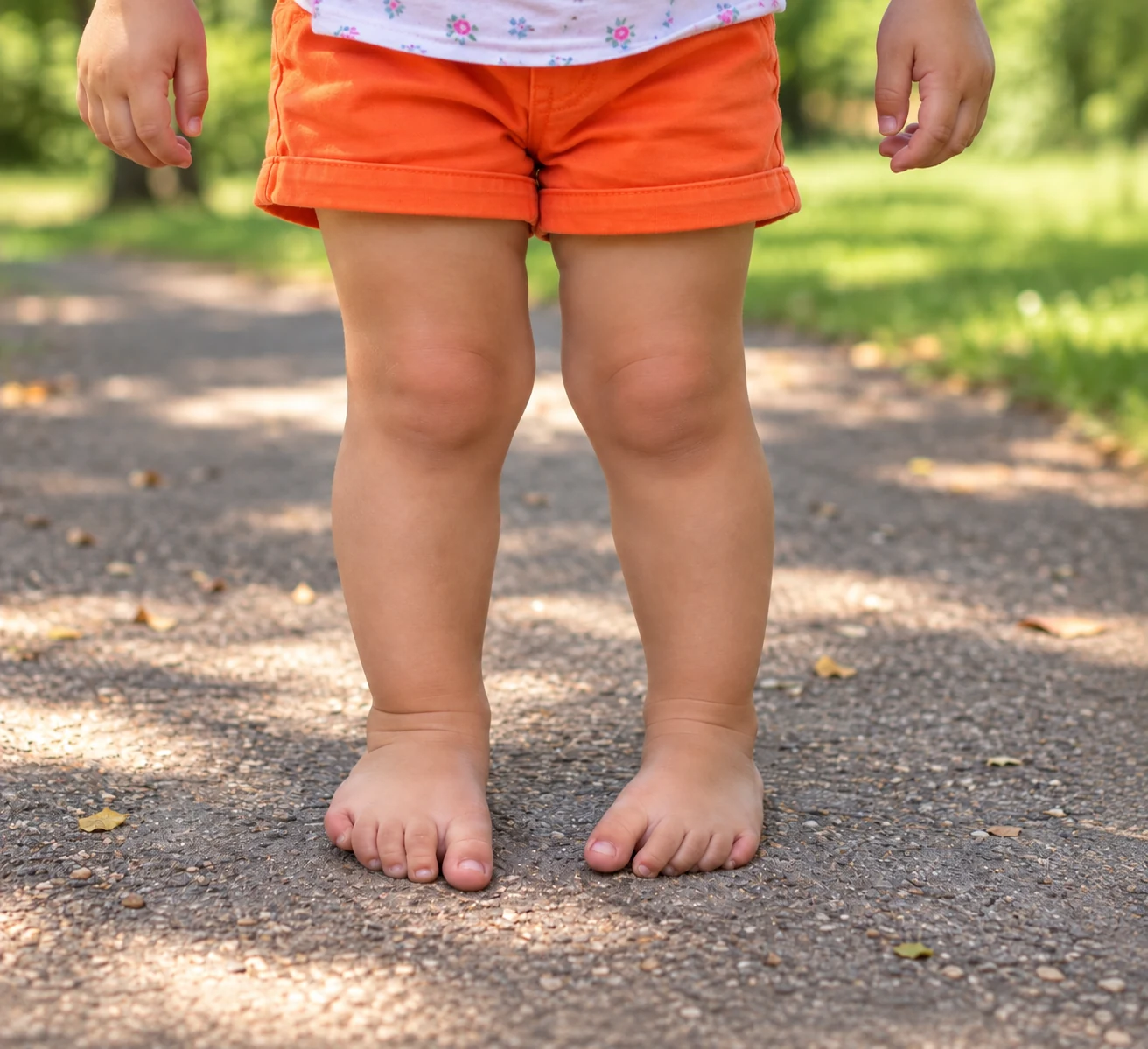
Metatarsus adductus affects the shape of the foot itself, giving the front of the foot a curved or bean-shaped appearance.
The important question is whether the foot is flexible. A flexible curved foot will usually straighten progressively as the baby grows, without any special treatment.
A foot that is markedly curved, stiff or difficult to bring gently towards a straight position is different. I’d recommend having it assessed rather than simply waiting. A small number of babies with more severe or persistent stiffness benefit from treatment, sometimes including a series of gentle corrective casts. This is one of the important exceptions to the general rule that intoeing needs no treatment.
2. Toddler’s feet turning in: internal tibial torsion
From around one to three years old, a common explanation is that the shinbone (tibia) is rotated inwards a little more than usual.
The kneecaps may point forwards while the feet point in. Parents sometimes describe this as the knees looking straight but the feet pointing towards each other. It is a variation in the rotational shape of the growing leg, not a sign that the bone has been injured.
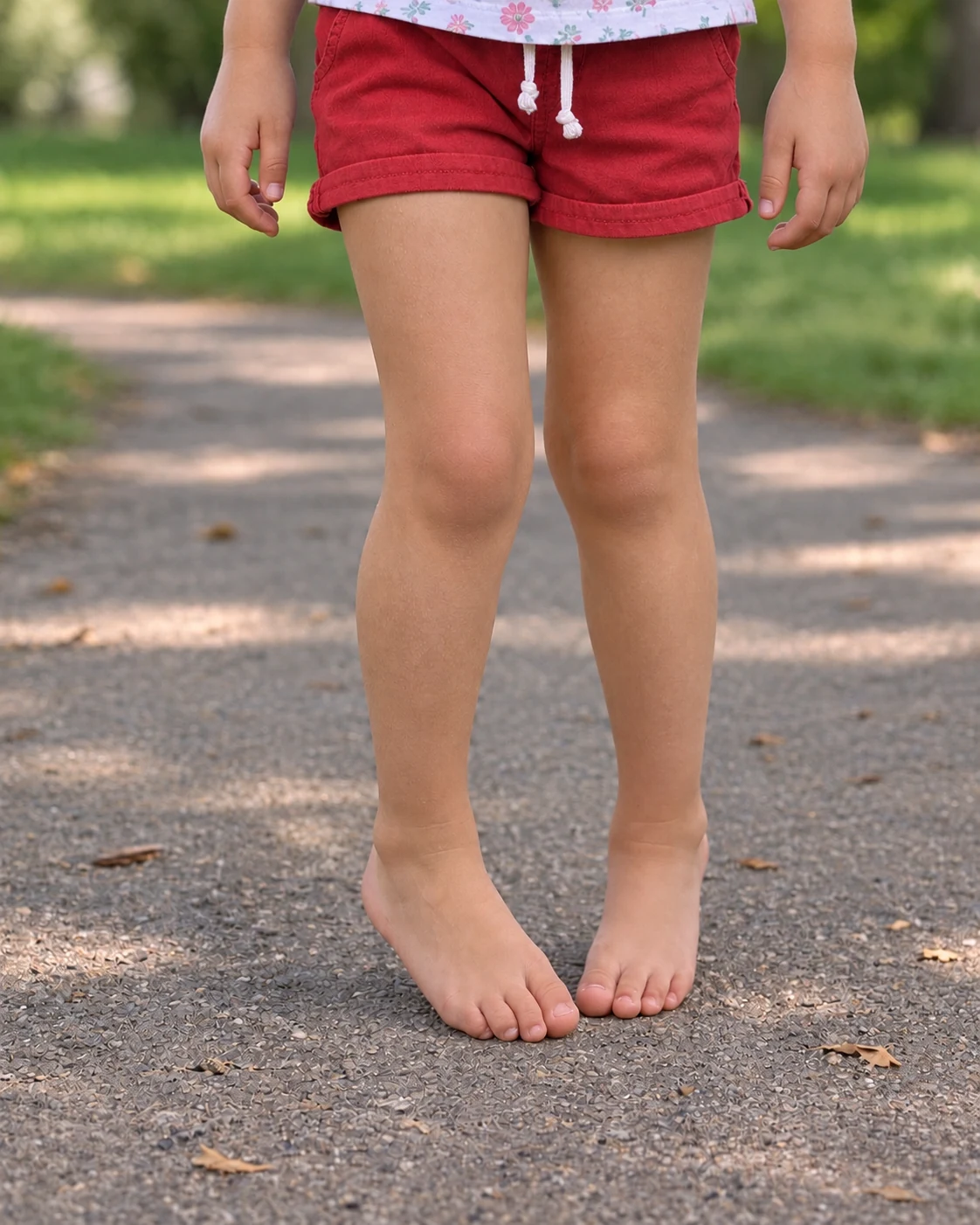
With internal tibial torsion, the knees may face forwards while the feet turn inwards.
As children grow, their shinbones generally rotate outwards. Most cases improve substantially during the preschool years, commonly by around five or six.
Special shoes, splints and exercises don’t make the bone untwist any faster. For most children, the sensible treatment is simply to let them grow.
3. Knees and feet turning in: increased femoral anteversion
In slightly older children, the inward turning often comes from the thighbone (femur), near the hip. We call this increased femoral anteversion.
Young children naturally have more inward rotation at the hips than adults. When that rotation is particularly noticeable, both the kneecaps and feet may turn inwards, especially when a child runs.

With increased femoral anteversion, both the kneecaps and feet may point inwards.
It often becomes most obvious at around four to six years old, then gradually improves through later childhood. Not every child ends up with feet pointing perfectly straight ahead, and they don’t need to. There is a broad range of normal.
Children with increased femoral anteversion are often very comfortable sitting in the position known as W-sitting. That leads to another common question.
Is W-sitting bad for my child?
For an otherwise healthy child, there’s no good evidence that W-sitting causes the thighbone to twist or damages the hips.
Children who have plenty of inward hip rotation often find W-sitting comfortable. In other words, the way their hips move can explain how they sit; sitting that way isn’t what created the underlying anatomy.
There is no need to spend the day correcting a child who is otherwise moving well and happily changing between sitting positions. If a child has pain, stiffness, difficulty moving, or wider developmental concerns, those deserve assessment in their own right.
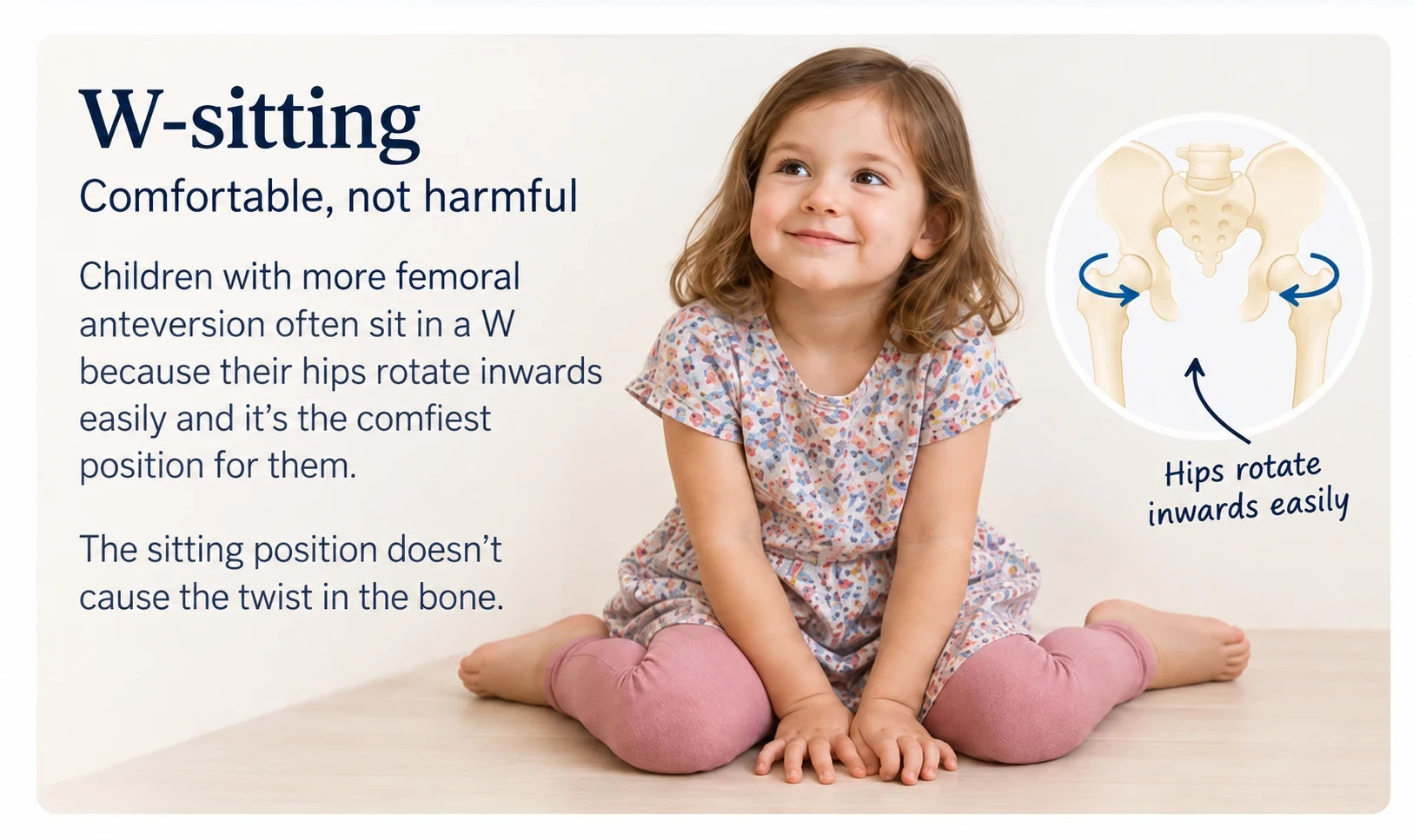
For a child with greater inward hip rotation, W-sitting often feels comfortable. It has not been shown to cause the underlying femoral twist.
W-sitting is often comfortable for children with more inward rotation at the hips. It has not been shown to cause femoral anteversion.
Will my child grow out of being pigeon-toed, and at what age?
Usually, yes — or it will improve enough that it no longer matters.
The timing depends on where the turning comes from. A flexible curved foot often improves in infancy and early childhood. Shin rotation typically improves through the preschool years. Femoral anteversion often takes longer, gradually changing through primary-school age and sometimes beyond.
The key is the overall pattern: a comfortable child who is active, developing normally and gradually improving is usually very reassuring.
Some children and adults continue to walk with their feet turned in slightly. That alone is not a problem.
Do pigeon toes need special shoes, insoles, braces or exercises?
For typical developmental internal tibial torsion or femoral anteversion, corrective shoes, insoles and braces do not alter the underlying twist of the bone. They aren’t routinely needed, and there’s no reason to spend money on them in the hope of making the feet point forwards.
Physiotherapy doesn’t physically untwist a growing femur or tibia either. It can, however, be helpful if a child has an additional difficulty with balance, coordination, strength or movement confidence. Those are separate issues worth addressing on their own merits.
The exception is the stiff or significantly curved foot in a baby, where an assessment may identify a role for specific treatment.
For most children, comfortable, properly fitting shoes and the freedom to run and play are all that’s required.
Will intoeing cause arthritis or knee problems when they’re older?
This is often the worry behind the question.
Ordinary developmental intoeing is not thought to cause arthritis later in life. It doesn’t mean the hip or knee is wearing out, and it isn’t damage to a joint.
There is a difference between a common childhood rotational variation and a severe, persistent rotational deformity that causes significant symptoms or interferes with movement. The latter is uncommon, but is something I would assess rather than dismiss.
Can my child still play sport?
In the great majority of cases, absolutely.
Children with intoeing can run, cycle, swim, play football and enjoy school sport. Some younger children do trip more often, particularly when running quickly, but this commonly improves as their balance, coordination and rotational alignment develop.
I wouldn’t stop a pain-free child from playing simply because their feet point inwards. What interests me far more than the appearance of their gait is whether they’re comfortable, keeping up with their friends and enjoying being active.
When should I worry about my child’s feet turning in?
Most children don’t need a specialist appointment. These are the things that would make me want to examine a child rather than simply reassure from a distance:
A marked difference between the two sides, particularly if one leg seems to have changed.
Intoeing that is becoming noticeably worse, rather than gradually improving.
A stiff or markedly curved foot, particularly in a baby.
Pain, swelling or a persistent limp. Typical developmental intoeing shouldn’t be painful.
New difficulty walking, unusual stiffness, persistent toe-walking or loss of previously acquired skills.
Wider concerns about development, balance or coordination.
Severe intoeing persisting into later childhood, especially when it causes frequent tripping or difficulty with everyday activities.
An unexplained limp should be assessed by a healthcare professional. A child who suddenly cannot bear weight, is very unwell or has a fever with a painful leg or joint needs urgent medical assessment rather than a routine appointment about intoeing.
And if you’re simply uncertain about what you’re seeing, a straightforward examination can often put your mind at rest.
Does intoeing ever need surgery?
Very rarely.
An operation to change the rotation of a shinbone or thighbone is a significant procedure. It is considered only in selected older children with a severe rotational difference that has not improved with growth and is genuinely affecting function or causing significant symptoms.
We don’t operate just to make a child’s feet look straighter. For the overwhelming majority, there is no need for an operation at all.
When should my child see a children’s orthopaedic surgeon?
If your child is pain-free, active, developing normally and their walking pattern is improving, there’s usually no urgency. Often the best thing is simply to carry on with childhood and let growth do its work.
If the pattern is markedly one-sided, painful, stiff, deteriorating, or causing significant difficulty, I’d recommend getting them examined. The same applies if things simply don’t seem to be following the course you’d expect.
And sometimes a parent just wants a clear explanation of what they’re seeing. That’s reasonable too. A reassuring examination and a proper conversation can be a useful outcome in themselves.
Worried about the way your child walks?
Most children with intoeing don’t need treatment, but some do benefit from an assessment. If you’re concerned about pain, asymmetry, stiffness or a walking pattern that isn’t improving, my practice manager Debbie can help arrange an appointment.
Ask Debbie about a consultation
Mr Nev Davies — Consultant Trauma & Orthopaedic Surgeon, Children’s Orthopaedics and Knee Surgery
Frequently asked questions about intoeing and pigeon toes
Is it normal for a 2-year-old or 3-year-old to walk with their feet turned in?
Yes. An inward twist of the shinbone is common at that age, although the foot and thigh can contribute too. Most children improve naturally as they grow.
Is pigeon-toed walking the same as intoeing?
Yes. Pigeon-toed is the everyday description; intoeing is the medical term.
At what age do children grow out of pigeon toes?
There isn’t one deadline. Flexible curved feet often improve early, internal tibial torsion usually during the preschool years, and femoral anteversion can take longer, often improving through primary-school age.
Why does my child trip over their feet when running?
Some young children with intoeing trip more often. If they’re otherwise well and gradually improving, that’s often reassuring. Frequent falls that are getting worse, cause injuries or come with weakness, pain or developmental concerns deserve assessment.
Can intoeing develop after my child has been walking normally?
A rotational pattern can become more noticeable as a child’s gait changes with age. But a genuinely new or worsening walking problem, particularly if it’s one-sided or painful, shouldn’t simply be assumed to be developmental intoeing.
Why does only one of my child’s feet turn in?
Intoeing can be more noticeable on one side. That does not automatically mean something is wrong, but a marked difference, especially if it is new, worsening or associated with pain or limping, is a good reason to arrange an examination.
Can exercises or physiotherapy straighten pigeon toes?
Exercises do not change the natural twist in the tibia or femur. Physiotherapy can still be helpful if a child is struggling with balance, strength or coordination, but it is not routinely necessary just to correct the direction of the feet.
More about children’s walking, legs and feet
You may also find these guides helpful: My child is limping: when to worry, My toddler isn’t walking yet, and Is it normal for a child to have flat feet?.