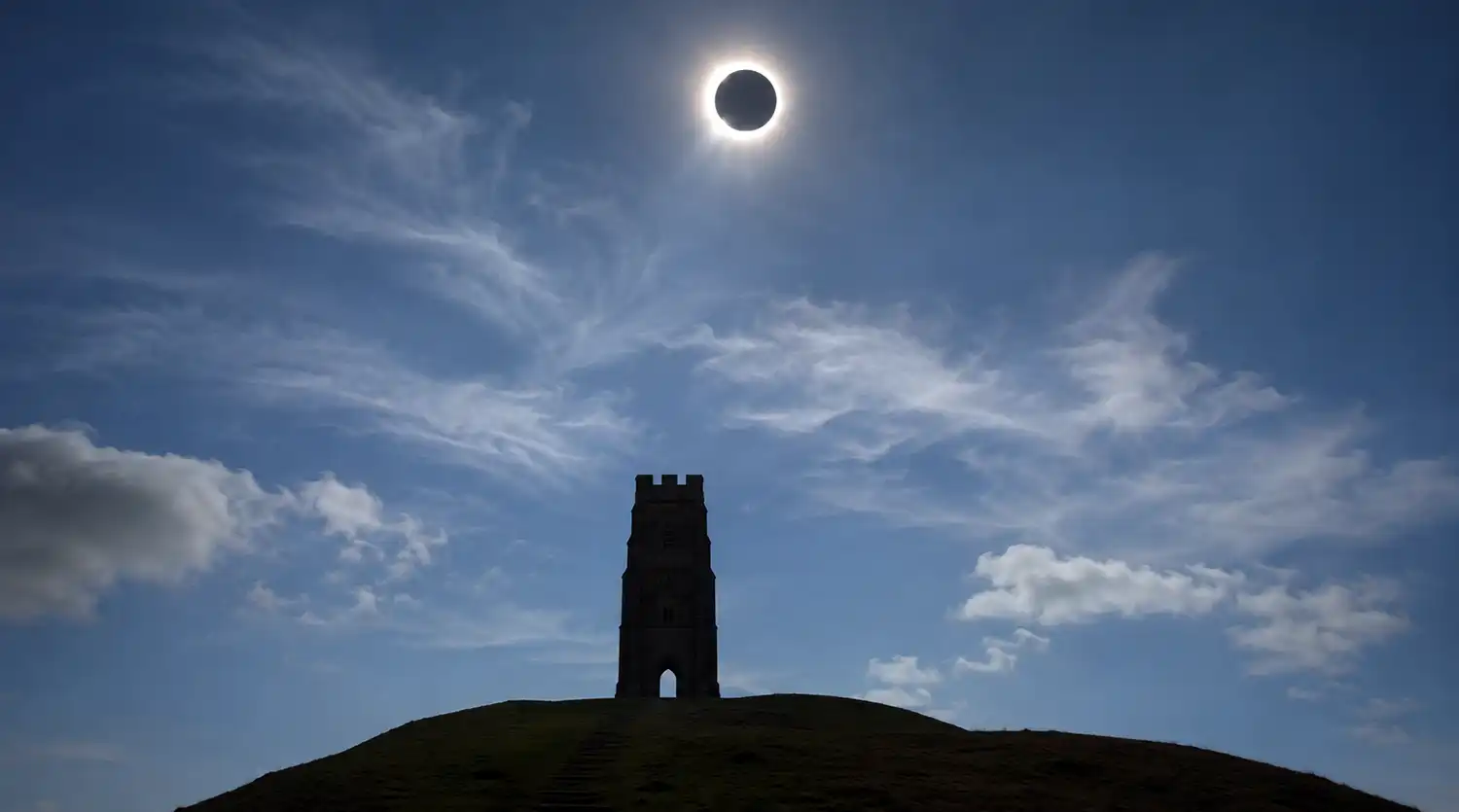
Can changes in the weather really make your knee hurt? And what about the Moon? With a major solar eclipse visible across the UK today, knee surgeon Mr Nev Davies looks at an idea that has fascinated patients and doctors for thousands of years.
Tonight, something rather special is happening above us.
On Wednesday 12 August 2026, the Moon will pass across the Sun. From London and the South East, the partial solar eclipse begins at around 6.17 pm and reaches its maximum at about 7.12 pm, when roughly 90% of the Sun will be covered.
And I would put money on somebody telling me in clinic that their knee can feel it.
Patients have been telling doctors for centuries that their joints respond to changes in the weather, the seasons and even the Moon.
The fascinating thing is that doctors used to agree with them.
So, can your knee really predict the weather? Does barometric pressure affect arthritis? And can the Moon possibly have anything to do with your joints?
The answer is more interesting than you might think.
We have been blaming the heavens for our health for thousands of years
The relationship between medicine and the sky is certainly not a new one.
For much of medical history, physicians believed that human health was intimately connected to the natural world around us.
The enormously influential Greek physician Galen, who lived in the second century AD, developed and popularised ideas based around the four bodily “humours”: blood, phlegm, yellow bile and black bile.

Good health depended on keeping these in balance.
For centuries afterwards, medicine was also intertwined with astrology. The movements of the Sun, Moon and planets could influence when treatments were given, when blood was let and even when operations were performed.
Thankfully, modern orthopaedic surgery has moved on a little.
But the underlying observation has never completely disappeared:
some people genuinely feel that their joints change with the weather.
Even Henry VIII’s doctors looked to the skies

By Tudor times, astrology remained part of mainstream medical thinking.
Henry VIII famously suffered from terrible problems with his legs later in life, including chronic ulceration following injuries, alongside increasing immobility and considerable pain.
His physicians worked in a world in which medicine, the four humours and astrology were still closely connected.
A Tudor doctor faced with a swollen and painful leg might therefore consider not only the patient’s body, but also the season and celestial influences.
Today we’d reach for examination, X-rays, MRI scans and blood tests rather than an astrological chart.
But perhaps the old doctors weren’t completely foolish to notice that our environment can affect how we feel.
The question is whether modern science can demonstrate it.
Why does my knee hurt when the weather changes?
This is something patients tell me remarkably often.
Some are absolutely convinced they can predict rain from their knees.
And there is some scientific evidence that they may be detecting something real.
Researchers have investigated temperature, humidity, rainfall and atmospheric or barometric pressure in people with osteoarthritis and other chronic painful conditions.
The results are mixed.
Some studies find little or no meaningful relationship. Others have found associations between osteoarthritis pain and factors including atmospheric pressure, humidity and temperature.
When researchers pool the evidence together, the most sensible conclusion is not that weather definitely causes joint pain, nor that it is all a myth.
It is that weather probably has a relatively small effect on symptoms in some people, and that effect varies considerably between individuals.
That fits rather well with what I see in clinic.
What is barometric pressure?
Barometric pressure is simply the pressure exerted by the atmosphere around us.
It changes as weather systems move across the country.
One theory is that small changes in atmospheric pressure allow tissues around an already irritated or arthritic joint to expand or contract very slightly.
Another possibility is that changes in temperature alter muscle stiffness and how freely we move.
There may also be changes in the sensitivity of the nerves around an arthritic joint.
These are plausible explanations.
But none has been definitively proven.
And there is another, rather less glamorous possibility.
Perhaps it isn’t all about the weather
Think about what happens on a cold, wet November Sunday.
We tend to walk less.
We sit more.
We spend longer indoors.
Muscles become colder and stiffer.
Our activity levels change.
Sleep and mood can change too, both of which influence how we experience pain.
An arthritic knee generally likes regular movement and strong muscles. Sitting still for several hours is often a very effective way of making it feel stiff and uncomfortable when you eventually stand up.
So the weather may affect your knee partly because it changes you, rather than because atmospheric pressure is physically squeezing your joint.
Can the Moon affect my knee?
This is where things become particularly entertaining.
The usual argument goes something like this:
The Moon controls the tides. Our bodies contain lots of water. Our joints contain fluid. Therefore the Moon must affect our joints.
It sounds wonderfully plausible.
Unfortunately, the physics doesn’t really work.
The Moon’s gravitational influence produces tides because oceans are enormous bodies of water extending over vast distances.
Your knee contains only a tiny quantity of synovial fluid.
The Moon isn’t pulling the fluid around inside your knee like the tide coming into Brighton.
So there is no convincing scientific evidence that the phases of the Moon themselves make arthritis worse.
What about tonight’s solar eclipse?
An eclipse doesn’t suddenly alter gravity or atmospheric pressure in a way that should make your knee hurt.
What it can do is temporarily change the light and temperature around us.
During this evening’s deep partial eclipse, the Moon will cover around 90% of the Sun from London, and even more from some western parts of Britain.
So if your knee does feel different tonight, I wouldn’t immediately blame the alignment of the solar system.
It may simply be cooler.
Or perhaps you’ve been standing outside for an hour staring at the sky.
One important aside: never look directly at the Sun during a partial eclipse without proper certified solar viewing protection. Ordinary sunglasses are not sufficient.
So am I imagining my weather-sensitive knee?
No.
Pain is complicated.
Two apparently identical arthritic knees can behave completely differently. One person can have dreadful-looking X-rays and relatively little pain, while another has comparatively modest changes but considerable symptoms.
Sleep, activity, muscle strength, previous injury, inflammation, mood and our nervous system all influence how we experience pain.
Weather may be another small part of that mixture for some people.
So if you consistently notice that your knee aches before a storm, I’m not going to tell you that you’re imagining it.
I just wouldn’t use your knee instead of the Met Office.
What about gout?
Gout deserves a special mention because weather may affect it rather differently.
Research has suggested that attacks can become more common during hot weather, particularly when dehydration becomes more likely.
That makes biological sense because dehydration can increase the concentration of uric acid in the blood.
So recurrent episodes of a suddenly very painful, hot and swollen joint, particularly the big toe, ankle or knee, deserve proper medical assessment rather than being blamed on the weather.
What actually helps an aching knee when the weather changes?
Whether or not your knee really is meteorologically gifted, the advice is reassuringly straightforward.
Keep moving
Gentle regular movement usually helps an arthritic knee more than prolonged rest.
I often tell patients that motion is lotion.
Keep the muscles strong
For knee arthritis in particular, maintaining good quadriceps, hamstring and hip strength can make an enormous difference to symptoms and function.
Keep warm
If your joints feel noticeably stiffer in cold conditions, warm clothing, a simple knee sleeve, a warm shower or bath and gently getting the joint moving can all help.
Look for patterns
If you’re convinced your knee responds to the weather, try keeping a simple diary for a few weeks.
Record your symptoms, activity, exercise and perhaps the weather.
You may discover a pattern.
You may equally discover that the strongest predictor of Tuesday’s painful knee was what you did on Monday.
When shouldn’t I blame the weather?
This is the important bit.
A change in weather should not be used to explain away a significant change in your knee.
Please seek medical advice if you develop:
significant or rapidly developing swelling
a hot, red or very tender joint
fever or feeling generally unwell alongside a swollen joint
inability to put weight through the leg
persistent locking or giving way
significant pain following an injury
persistent night or rest pain
a clear deterioration that isn’t settling
Those symptoms deserve assessment irrespective of what the weather forecast says.
The short answer
Can weather affect knee pain?
Probably, in some people and usually to a relatively small degree.
Can changes in barometric pressure affect arthritis?
Possibly. Studies have produced mixed results, although some research has found an association.
Can the Moon make your knee hurt?
There is no convincing evidence that it does.
Will tonight’s solar eclipse affect your arthritis?
Almost certainly not.
But humans have spent thousands of years looking towards the sky for explanations for what happens inside our bodies.
From Galen and the four humours, through Tudor physicians and Henry VIII’s troublesome legs, to somebody sitting in my clinic telling me that rain is coming because their knee has started aching, perhaps we haven’t changed quite as much as we think.
Enjoy the eclipse.
Just don’t forget your eclipse glasses.