A parent’s guide to painful, infected and recurrent ingrowing toenails, and when treatment or surgery might be needed.
By Mr Nev Davies, Consultant Trauma & Orthopaedic Surgeon, specialising in Children’s Orthopaedics
An ingrowing toenail might sound like a fairly minor problem. But anyone who has had one, or has a child struggling with one, will know just how painful and frustrating it can become.
A tiny corner of toenail can make wearing school shoes uncomfortable, put an end to football or rugby training, and occasionally become so inflamed that even the lightest touch is painful.
For parents, the difficulty is often knowing what to do next. Should you cut the offending corner out? Soak the toe in warm water? Ask for antibiotics? Or is it something that might eventually need an operation?
The reassuring news is that many ingrowing toenails improve with simple treatment. However, when the same problem keeps returning, particularly with repeated inflammation or infection, it may be time to consider a more lasting solution.
Let’s look at why ingrowing toenails happen, what you can safely do at home, and when it’s worth getting some help.

An ingrowing toenail can cause significant inflammation and pain, even when only a small corner of nail is involved.
What actually happens when a toenail becomes ingrown?
The name is slightly misleading because the nail doesn’t necessarily start growing in a completely different direction.
Normally, your toenail grows forwards over the skin underneath it, called the nail bed. The edges of the nail sit alongside folds of soft skin, known as the nail folds.
Problems begin when the edge or corner of the nail presses into, or actually penetrates, the skin alongside it. This causes irritation and inflammation, making the surrounding tissue red, swollen and painful.
Unfortunately, this can become a vicious circle. As the skin swells, it presses more firmly against the nail, which causes further irritation and swelling.
In some children, the shape of the nail contributes to the problem. Rather than being relatively flat, the nail curves downwards and inwards at the sides. This is sometimes called an involuted or pincer-shaped nail, and it can make the edges particularly troublesome.
If the irritation continues, the surrounding skin may develop extra red, fleshy tissue called hypergranulation tissue. It can look alarming, bleed easily and sometimes become infected.
Most ingrowing toenails affect the big toe, although occasionally other toes can be involved.

The normal toenail sits between folds of skin. When the nail edge curves downwards or presses into the surrounding tissue, it can cause inflammation and an ingrowing toenail.
Why do children and teenagers get ingrowing toenails?
There is rarely one single explanation, although some causes are particularly common.
Cutting the toenails too short
One of the biggest contributors is trimming the nail too short or cutting deeply down its sides.
It seems logical to remove the painful corner, but this can actually make matters worse. As the nail grows forwards again, its new edge may press into the surrounding skin, restarting the whole process.
This is why repeatedly digging out the corner of an ingrowing toenail is rarely a good long-term solution.
Tight school shoes and sports boots
Children’s feet grow quickly, and shoes that fitted perfectly a few months ago may now be squeezing their toes.
Football boots are particular offenders because they are often designed to fit closely around the foot. Repeated pressure against the side of the big toenail can aggravate an already irritated nail fold.
The natural shape of the nail
Some children are simply born with relatively wide or naturally curved toenails. The edges may curl downwards more than usual, making them more likely to press into the surrounding skin.
This is worth understanding because it explains why some children experience recurrent ingrowing toenails despite apparently doing everything correctly.
Other contributing factors include sweaty feet, repeated minor trauma during sport, picking at the nails and tearing them rather than trimming them properly.
Sometimes there is no obvious reason at all.
How do I know if my child’s toenail is ingrowing?
The earliest sign is usually tenderness along one side of the big toenail, particularly when the toe is squeezed or pressed against a shoe.
As the problem develops, parents may notice:
Redness and swelling along the nail edge.
Pain when wearing school shoes, trainers or football boots.
The skin appearing to grow over the side of the nail.
Red, fleshy tissue developing beside the nail.
Bleeding, crusting or discharge.
Pus or increasing warmth if infection develops.
Some children have a relatively mild problem that comes and goes. Others develop a persistently swollen, painful toe that never seems to settle completely.
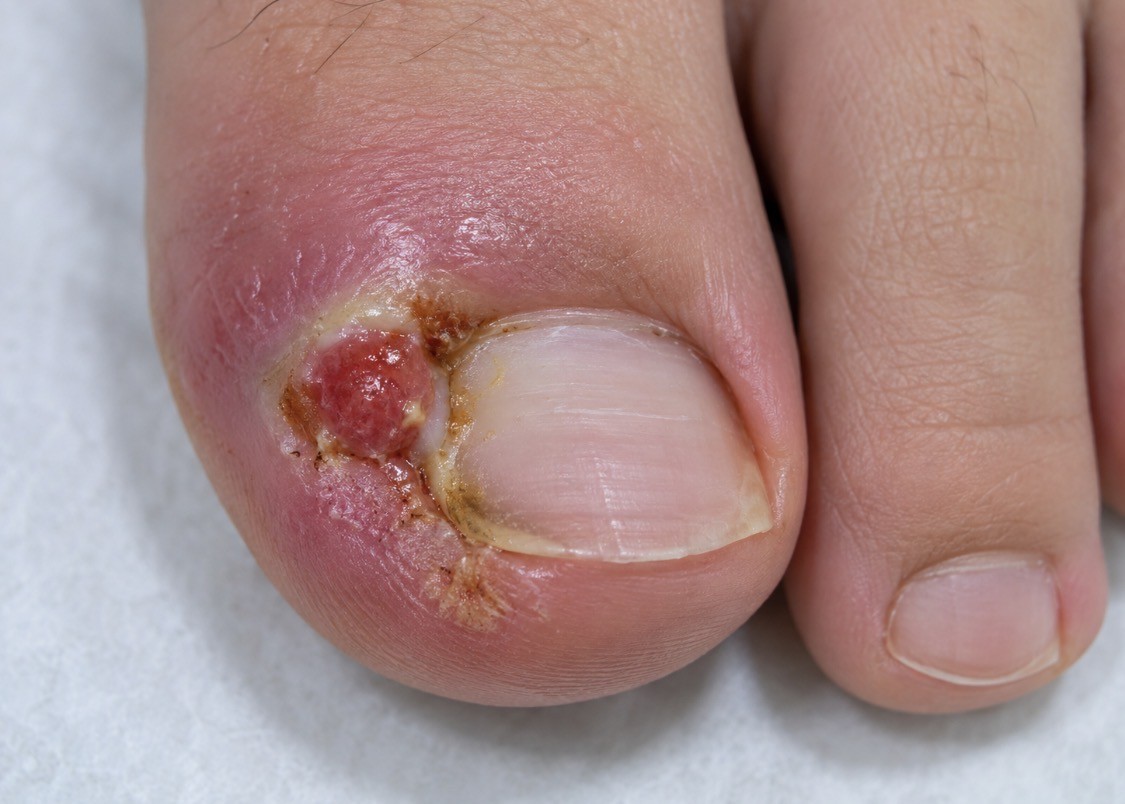
A more advanced ingrowing toenail. The red, fleshy tissue alongside the nail is called hypergranulation tissue and develops in response to prolonged irritation.
What can I do at home to help an ingrowing toenail?
For a mild or recently developed ingrowing toenail, there are several sensible things you can try before considering more invasive treatment.
1. Stop cutting down the sides of the nail
This is probably the most important piece of advice.
Resist the temptation to dig around the painful corner with nail scissors or clippers. Although removing a small piece of nail might give temporary relief, it can damage the skin and create another sharp edge that causes problems as the nail grows.
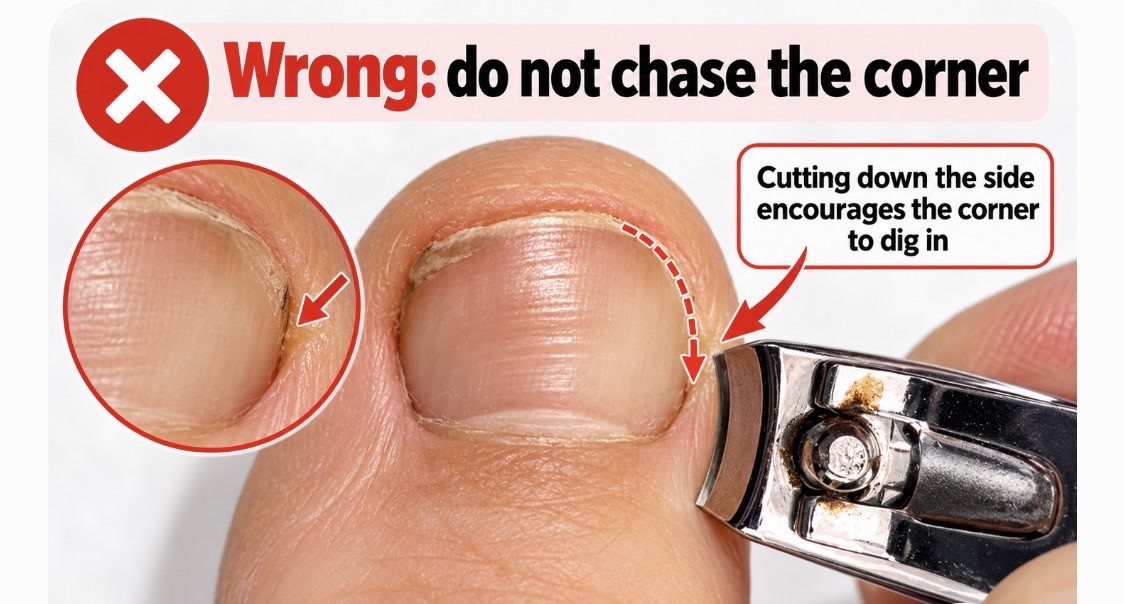
Avoid cutting toenails too short or digging down the sides.
Instead, allow the nail to grow forwards. When it needs trimming, cut it reasonably straight across, without cutting too short or deeply rounding the corners.
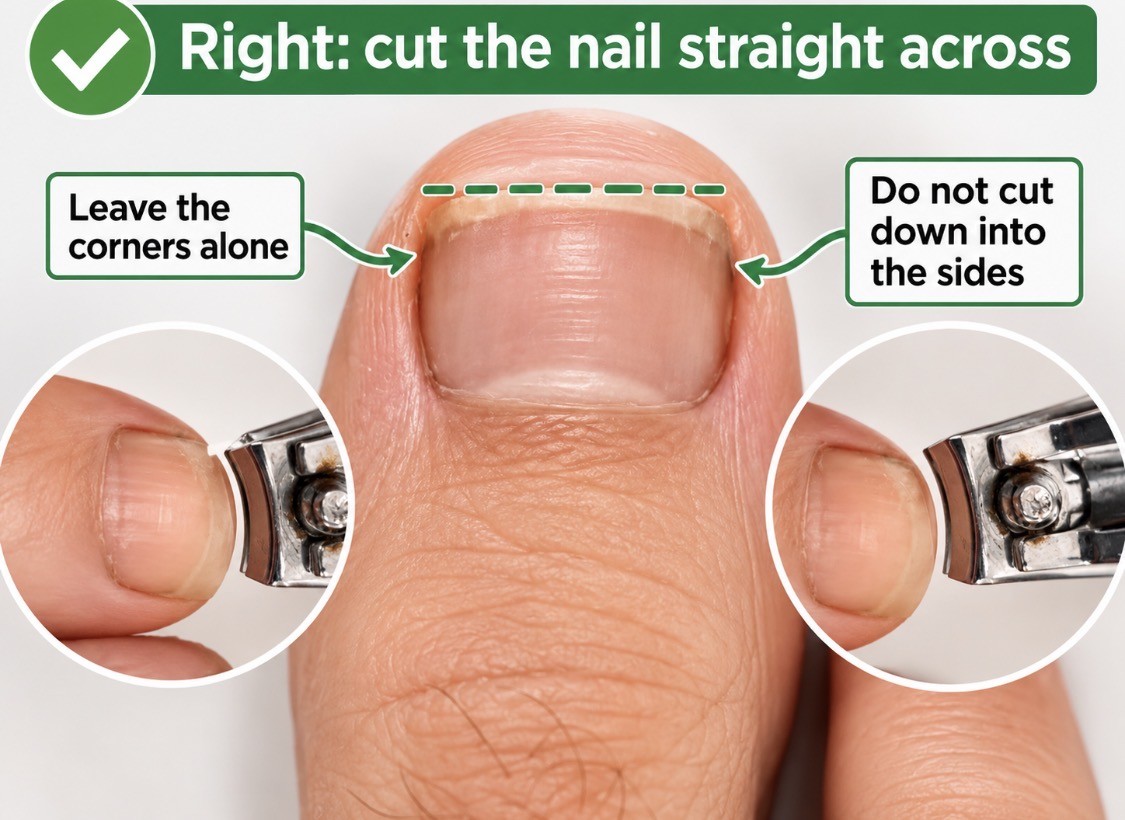
Leaving the corners visible helps prevent the nail edge from becoming trapped in the surrounding skin.
2. Keep the toe clean
Gently washing the toe with soap and water and drying it carefully afterwards can help keep the area clean.
A short soak in warm, salty water may also ease discomfort. Avoid prolonged soaking that leaves the skin excessively soft and soggy.
If there is a little discharge, a clean, non-stick dressing can protect the area from rubbing against footwear.
3. Give the toes some space
Check that your child’s shoes have enough room around the toes.
If the toe is particularly sore, wider-fitting trainers or open-toed footwear may be more comfortable for a short period.
If football boots or another sporting activity are continually aggravating the nail, temporarily reducing that activity may allow the inflammation to settle.
4. Simple honey dressings
Dabbing on a small amount of runny honey with a cotton bud into the skin fold is an effective and natural antiseptic.
5. Try not to pick at it
Children and teenagers understandably fiddle with things that hurt. Unfortunately, repeatedly picking at the skin or pulling at the nail can prolong the inflammation and introduce bacteria.
For pain, age-appropriate paracetamol or ibuprofen may help if suitable for your child. Follow the recommended dosing advice.
In mild cases, these simple steps may be enough to settle the irritation and allow the nail to grow beyond the troublesome skin fold.
Does a red or infected ingrowing toenail always need antibiotics?
No, and this is an important distinction.
An ingrowing toenail can produce a surprisingly impressive amount of inflammation even without a significant bacterial infection.
Redness, swelling and tenderness are often caused by the nail repeatedly irritating the surrounding tissue. The presence of hypergranulation tissue does not automatically mean antibiotics are required either.
However, infection can develop when bacteria enter the damaged skin. Increasing redness, warmth, swelling, pus or redness spreading beyond the nail fold are reasons to seek medical assessment.
Antibiotics may be appropriate if there is a spreading skin infection, but they do not remove the offending piece of nail.
This explains why some children improve while taking antibiotics, only for the problem to return when the course finishes.
The underlying mechanical problem may still be there.
If the nail edge continues to irritate the skin, further treatment may be needed to break that cycle.
When should I get my child’s ingrowing toenail checked?
You don’t need to rush to a specialist for every slightly sore toenail. However, I would recommend assessment by a GP or podiatrist if:
The pain is persistent or getting worse.
Your child is struggling to wear normal shoes.
The problem is stopping them enjoying sport or everyday activities.
There is repeated bleeding, discharge or fleshy tissue growing around the nail.
The toe keeps becoming inflamed or infected.
Simple home treatment has not helped.
Seek prompt medical advice if there is pus, significant swelling or redness spreading beyond the nail fold. A child who develops a fever, becomes generally unwell or has rapidly spreading redness needs urgent assessment.
Children with diabetes, poor circulation or a weakened immune system should also be assessed promptly rather than relying on home treatment.
For most children, a GP or appropriately qualified podiatrist is a very sensible first point of contact.
Why does my child’s ingrowing toenail keep coming back?
This is often the most frustrating part of the problem.
The toe becomes painful and inflamed, settles for a few weeks after treatment, and then flares up again.
Sometimes the explanation is relatively straightforward. A sharp corner of nail remains beneath the skin or develops again as the nail grows forwards.
In other children, the underlying shape of the nail means the same edge repeatedly presses into the surrounding tissue.
It’s also important to understand where the nail actually comes from.
The visible nail plate is produced by specialised tissue beneath the skin at the base of the nail, called the germinal matrix. This is effectively the nail’s growth centre.
Simply cutting away the troublesome nail edge doesn’t necessarily change what grows back.
If that same section of nail continues to be produced, the problem can recur.
Understanding this is central to deciding whether an operation might help.
When does an ingrowing toenail need surgery?
Surgery isn’t necessary for most children with a first or relatively mild ingrowing toenail.
However, when the toe remains painful despite appropriate non-operative treatment, repeatedly becomes inflamed or infected, or significantly interferes with normal activities, a small surgical procedure can be worth considering.
There are several ways of treating an ingrowing toenail, depending on the severity of the problem and the shape of the nail.
Removing the troublesome edge of nail
One option is to remove the narrow strip of nail that is digging into the surrounding skin. This is known as a partial nail avulsion.
The remaining nail is preserved, so the toe continues to have a largely normal-looking toenail.
Removing that strip relieves the pressure on the surrounding tissue and allows the inflamed skin to heal.
However, if the nail-producing tissue remains intact, the removed strip can eventually grow back and potentially cause the same problem.
Preventing the troublesome edge from growing back
For recurrent ingrowing toenails, it may be sensible to go one step further.
After removing the affected strip of nail, the corresponding part of the nail-producing matrix can be treated or removed so that it no longer produces that troublesome edge.
This can be achieved using different techniques, including a chemical treatment such as phenol or surgical removal of the relevant matrix tissue.
The result is a slightly narrower toenail, but one that is much less likely to repeatedly dig into the skin on that side.
No procedure can guarantee that an ingrowing toenail will never recur, and the choice of technique involves balancing recurrence risk, healing time and the final appearance of the nail.
Does the whole toenail need removing?
Not usually.
For many recurrent ingrowing toenails, only the affected side needs treatment.
Removing the entire nail is sometimes appropriate, particularly in more complex cases, but it isn’t routinely necessary.
The best approach depends on the child’s symptoms, the nail’s shape, previous treatment and the extent of the problem.
What is recovery like after ingrowing toenail surgery?
This naturally worries parents, especially when their child is busy with school and sport.
Many nail procedures can be performed with local anaesthetic to numb the toe. For some younger or particularly anxious children, a different anaesthetic approach may be appropriate.
Afterwards, the toe is dressed and the family is given instructions about cleaning, dressings, footwear and activity.
Some discomfort, swelling and discharge can be expected while the area heals, particularly when the nail matrix has been treated. Complete healing can take several weeks, depending on the procedure.
Children can often return to ordinary activities before healing is complete, provided the toe is comfortable and protected. Returning to football, rugby, running or other activities involving tight footwear or repeated impact may take longer.
The precise recovery plan should be discussed with the clinician performing the procedure.
When should my child see an orthopaedic surgeon?
Most children with an ingrowing toenail will never need to see a surgeon.
Good nail care, appropriate footwear and treatment from a GP or podiatrist are often all that is required.
However, I do see children with persistent or recurrent ingrowing toenails, particularly when simpler treatment has failed and the family wants to understand whether an operation would provide a more lasting solution.
My approach is to consider how troublesome the nail is, how frequently it becomes inflamed or infected, and whether there is an underlying nail shape that makes recurrence more likely.
If the problem can reasonably be managed without an operation, that is always worth discussing.
But equally, there comes a point when repeatedly treating the same painful, infected toe becomes frustrating for everyone.
A small problem anatomically can have a surprisingly big impact on a child’s life.
A child who cannot comfortably put on their school shoes, run around the playground or enjoy their sport deserves to have that problem taken seriously.
And if an ingrowing toenail keeps coming back despite doing all the right things, it’s entirely reasonable to explore a more definitive treatment.
Frequently asked questions about ingrowing toenails in children
Can an ingrowing toenail heal by itself?
Yes. Mild cases can settle as the nail grows forwards, particularly when pressure from footwear is reduced and the surrounding skin is allowed to recover. Persistent or recurrent ingrowing toenails are less likely to resolve without additional treatment.
Should I cut the corner out of my child’s ingrowing toenail?
Generally not. Digging down the side of the nail can damage the skin and leave another sharp edge that causes irritation as the nail regrows. If the nail edge is embedded or very painful, professional treatment is safer.
Is it normal for an ingrowing toenail to bleed?
Bleeding can occur when the nail damages the surrounding skin, particularly if hypergranulation tissue has developed. Recurrent bleeding or discharge should be assessed.
Does an ingrowing toenail always need antibiotics?
No. Redness and swelling may be caused by inflammation rather than infection. Antibiotics may be required for a spreading bacterial infection, but they do not correct the nail edge responsible for the problem.
Is ingrowing toenail surgery painful for children?
The toe is usually numbed with local anaesthetic before the procedure, although other anaesthetic options may be considered for some children. Some discomfort is expected afterwards, but this can usually be managed with appropriate pain relief.
Will the toenail grow back after surgery?
It depends on the procedure. If a strip of nail is removed without treating its growth centre, it can grow back. When the relevant part of the nail matrix is successfully treated, that edge should no longer regrow, leaving a slightly narrower nail.
How can I stop my child’s ingrowing toenail from returning?
Cut toenails straight across without trimming too short, avoid digging down the sides, choose properly fitting footwear and keep the feet clean and dry. Children with naturally curved nails may remain prone to recurrent problems despite these precautions.
Worried about your child’s ingrowing toenail?
If your child’s ingrowing toenail is persistently painful, repeatedly infected or hasn’t improved despite appropriate treatment, I would be happy to assess it and discuss the options with you.
The aim is straightforward: to settle the problem, reduce the likelihood of recurrence and get your child comfortably back into their shoes and enjoying their activities.
Ask Debbie about a consultation
Mr Nev Davies — Consultant Trauma & Orthopaedic Surgeon, Children’s Orthopaedics & Knee Surgery
More from the Worried Parents series
You may also find these guides helpful: Why do my child’s feet turn in? Intoeing explained, Sever’s condition (children’s heel pain), Is it normal for a child to have flat feet? and My child is limping: when to worry. You can find all of Nev’s articles on the blog.
This article provides general information for parents and is not a substitute for an individual medical assessment.